

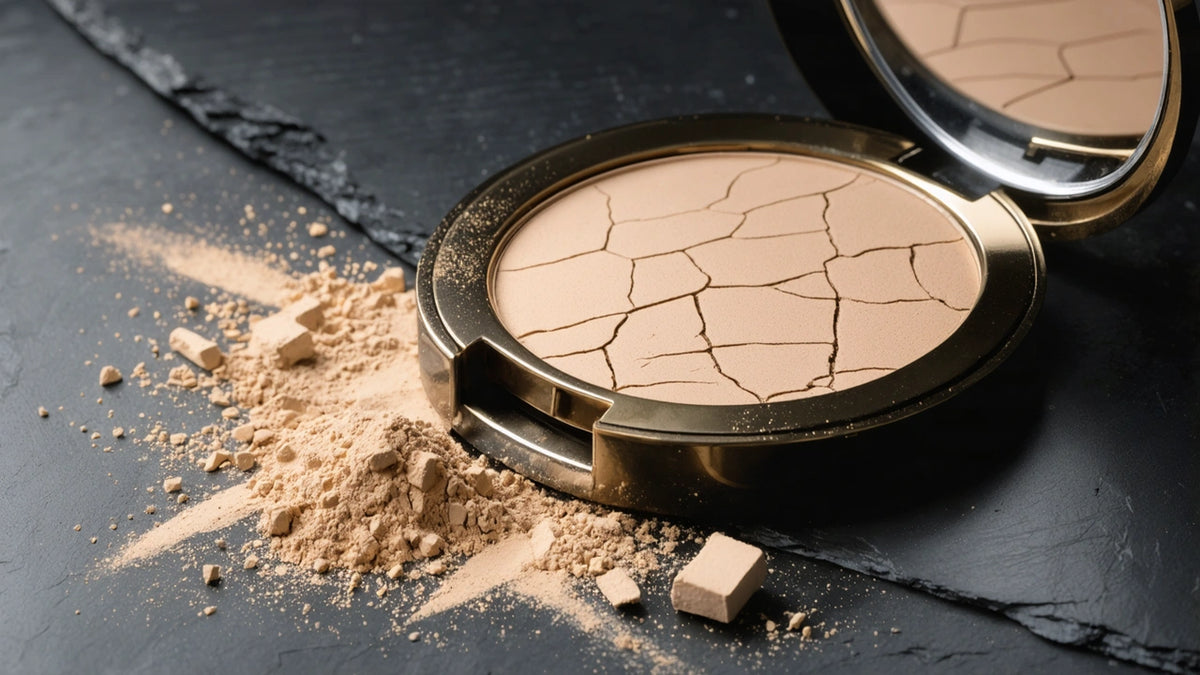
 Kaolin clay is a soft, naturally occurring mineral powder (INCI: Kaolin) with a porous, plate-like structure that holds excess oil and sweat on the skin's surface instead of letting it pool and break up your base. That single property is why kaolin clay makeup for humid weather has become the not-so-secret weapon of every Indian girl who has watched her foundation slide off her nose by 2 pm. If your compact contains kaolin, it is not just sitting on top of your face looking pretty — it is doing quiet, unglamorous absorption work while you sit in traffic on the Western Express Highway. Here is exactly how it works, and how to use it so you never look powdery.
What Is Kaolin Clay and Why Is It in Your Compact?
The 30-second definition
Kaolin — also called China clay — is a fine white-to-cream mineral powder milled from kaolinite. Under magnification it looks like a stack of tiny plates with air gaps between them, and those gaps are the whole point: they give the powder a large surface area relative to its weight, so it can take up oil and moisture rather than skidding around on it. In colour cosmetics, kaolin is generally used as a soft-focus filler and an oil-absorbing base ingredient, which is why you will find it in pressed powders, compacts and mattifying primers rather than in dewy liquid foundations. It is also naturally low-slip, which is a polite way of saying it grips.
Why humid India needs it
Kaolin clay is a fine, porous mineral powder that absorbs excess oil and sweat on the skin's surface, which is why it is used in compacts like the SUGAR POP 20 HR Longwear compact with Kaolin Clay and Vitamin E to keep makeup matte through Indian humidity.
Here is the India-specific problem. In dry-heat climates, makeup fails because it dehydrates and cracks. In our climate — 80% humidity in Mumbai, sticky Kolkata evenings, a Chennai afternoon that feels like a steam room — makeup fails because the air is already saturated, so sweat has nowhere to evaporate to. It just sits there, mixes with sebum, and lifts your base. Many Indian skin tones fall into the Fitzpatrick III to V range, and these skin types frequently combine an oilier T-zone with visible warm undertones, which means shine does not read as a soft glow — it reads as a bright, silvery patch on the forehead and nose in photos. An absorbent mineral like kaolin tackles the cause, not just the reflection.
How Does Kaolin Clay Absorb Oil Without Flattening Your Glow?
Absorb versus blur: the difference
These two get used interchangeably in marketing, and they should not be. Blurring powders — often silicone elastomers or spherical polymers — work optically. They scatter light so pores and texture look softer, but they do not necessarily remove oil from the equation. Kaolin works physically: the porous mineral takes up oil into and between its particles, reducing what is available on the surface to break down your foundation. Both are useful. But in a Delhi September, optical trickery alone loses. You want the powder that actually holds the oil.
Why it beats reaching for blotting paper
Blotting sheets are brilliant at removing oil — and also brilliant at removing the foundation, concealer and blush sitting in that oil. You blot, you look matte for eleven minutes, and then you are shiny again on bare skin with nothing left to hold it. A kaolin compact does two things at once: it absorbs, and it leaves behind a fresh layer of powder that keeps absorbing. That is the difference between a fix and a reset.

The Vitamin E balance
A compact that is all clay and no comfort is how you end up looking like you dusted your face with atta. Vitamin E is the counterweight. It brings a whisper of conditioning slip so the powder blends into the base rather than sitting on top of it in a visible film — especially important on medium-to-deep skin, where an over-powdered finish can look ashy in daylight. This is why a well-built oil absorbing compact is a balancing act: enough kaolin to control shine, enough Vitamin E to keep it looking like skin. If you want the full routine logic around this, our guide to makeup for oily skin in humid weather maps the whole layering order.
Kaolin Clay vs Other Shine Control Ingredients: What Actually Wins?
No single product does everything. Here is the honest head-to-head so you can build a kit instead of hunting for one miracle.
| Shine fighter | How it works | Best for | Limitation |
|---|---|---|---|
| Kaolin clay | Porous mineral absorbs surface oil and sweat | All-day humid wear, T-zone control, touch-ups | Needs Vitamin E or emollients to avoid a dry finish |
| Silica | Spherical particles blur texture and absorb some oil | Soft-focus photo finish, pore blurring | More optical than absorbent on very oily skin |
| Blotting sheets | Lift oil off mechanically | Emergency de-shining before a photo | Removes makeup with the oil, no lasting layer |
| Setting spray | Film formers lock layers together | Stopping transfer and movement of the base | Does not absorb oil produced after application |
Kaolin vs silica
Think of silica as the photographer and kaolin as the bouncer. Silica makes the finish look refined; kaolin decides how much oil gets to the party. Most good compacts use both.
Kaolin vs setting spray
A setting mist is a finisher, not a shine controller. It welds your layers together and takes away the powdery edge — which is exactly why it belongs at the end of the routine, after your kaolin compact has done the absorbing.

How Do You Use a Kaolin Clay Compact in 40°C Humidity?
Technique matters more than product here. Most powder disasters are application errors, not formula failures.
- Prep and base first. Hydrate, apply sunscreen, then your base. Powder over a cream base always looks better than powder over bare skin — try a few taps of Ace Of Face Foundation Stick on the areas that need coverage, or a lighter BB-style base if you want a no-makeup finish.
- Wait 60 seconds. Let the base settle so the powder does not drag it around. This one pause saves you from patchiness.
- Press, never sweep. Load the puff, fold it, then press and roll the powder into the skin. Sweeping moves your foundation sideways and creates streaks; pressing sets it where it is. This is the single biggest upgrade to your compact game.
- T-zone first, cheeks last. Start at the forehead, nose and chin where sebum is heaviest, then use whatever is left on the puff for cheeks. Cheeks rarely need a full layer, and over-powdering there is what kills a healthy finish.
- Set the danger zones. Under the eyes, along the sides of the nose and the upper lip — the places sweat and glasses cause slippage.
- Mist to finish. A light setting mist melts the powdery look into skin and locks the layers.
- Touch up by pressing, not piling. The midday rule: blot the shine with the clean side of the puff or a tissue first, then press a thin layer of powder. Powder over wet shine cakes; powder over blotted skin looks fresh.
If you want SPF built into your midday step, the Dream Cover SPF15 Mattifying Compact Powder is a smart daytime alternative — though a dedicated sunscreen underneath is still your primary sun step, always.
Who Should Use a Kaolin Compact, and Who Should Go Lighter?
Oily and combination skin: go in
If you are blotting by lunch, a kaolin-based 20 HR longwear compact is the most cost-effective upgrade in your kit. Keep it in your bag, use it as a touch-up tool rather than a full second layer, and let your T-zone take the bulk of it. For a deeper dive into picking the right one, read our breakdown of the anti-melt science behind kaolin clay makeup in humid weather.
Dry skin and the autumn transition: go lighter
When the monsoon ends and the air dries out, your oil output usually drops with it. This is the moment to reduce powder and increase hydration underneath — a hyaluronic serum layer, a dewier base, and kaolin powder reserved for the nose and chin only. Dry and mature skin should also avoid pressing powder into fine lines around the eyes; a whisper is plenty. And if you are layering active ingredients under makeup through the season change, our explainer on choosing the right form of Vitamin C serum for Indian skin is a useful companion read. For shopping specifics, the compact powder buying guide for oily skin in humid India compares finishes shade by shade.
Frequently Asked Questions About kaolin clay makeup for humid weather
What is kaolin clay in makeup?
Kaolin clay is a fine, naturally occurring mineral clay used in makeup formulas to soak up excess oil and shine without drying out skin. In compacts and powders, it works as a mattifying agent that sits on the surface of skin and traps sebum before it can break down your base. It's gentler than harsher clays like bentonite, which makes it a popular pick for daily-wear face powders, especially in hot, humid climates where oil control is non-negotiable.
How does kaolin clay control oil on the face?
Kaolin clay controls oil by physically absorbing excess sebum on the skin's surface rather than blocking pores. Its fine particles have a large surface area, so they soak up moisture and oil as it rises through the day, keeping your base looking fresh instead of sliding off by noon. Unlike silica-based mattifiers that can sit visibly on skin, kaolin clay tends to blend in more naturally, giving a soft-focus finish rather than a flat, powdery look.
Is kaolin clay good for oily and acne-prone skin?
Yes, kaolin clay is generally well suited to oily and acne-prone skin because it manages excess sebum without stripping the skin barrier. Its gentle, low-abrasion nature makes it milder than clays like bentonite, so it's less likely to trigger dryness-induced breakouts. That said, if you have very dry or mature skin, using a kaolin clay compact daily could feel a touch dehydrating, so it's worth balancing it with a hydrating base underneath or using it only on your T-zone.
Can a kaolin clay compact be used every day?
Yes, kaolin clay compacts are gentle enough for daily use for most skin types, especially oily and combination skin. Because kaolin is milder than other absorbent clays, it doesn't typically cause the tightness or flaking that comes with heavier mattifying powders. If your skin leans dry, you can still use it daily but consider applying it only where you need it most, like the nose and forehead, rather than an all-over layer, to avoid an overly matte or cakey finish.
How do I remove kaolin clay makeup properly at the end of the day?
Removing kaolin clay makeup properly starts with a gentle oil-based or micellar cleanser to break down the mattifying layer before it dries further on skin. Because kaolin clay is designed to grip oil and stay put in humidity, a quick rinse with water alone often isn't enough to fully clear it. Follow up with a hydrating cleanser or toner to replenish moisture, since clay-based products can leave skin feeling slightly parched by day's end if not properly rehydrated.
Does kaolin clay makeup work better than setting spray in humid weather?
Kaolin clay and setting spray solve different problems, so neither fully replaces the other in humid weather. Kaolin clay tackles oil and shine by absorbing sebum at the source, while setting spray creates a thin film that helps makeup resist sweat and humidity-related smudging. For the best anti-melt result in extreme humidity, most people layer both: a kaolin clay compact to control oil throughout the day, topped with a setting spray to lock everything in place.
Shop SUGAR Cosmetics
If your shine has been winning lately, let the clay take a shift. The SUGAR POP 20 HR Longwear Compact with Kaolin Clay and Vitamin E is the wallet-friendly place to start — kaolin for the absorbing, Vitamin E for the comfort, and shades built for fair to deep Indian skin tones. It is cruelty-free, it fits in the smallest sling bag, and it is genuinely made for our weather. Swatch the shades and find your match on sugarcosmetics.com.

%20with%20a%20porous,%20plate-like%20structure%20that%20holds%20excess%20oil%20and%20sweat%20on%20the%20skin's%20surface%20instead%20of%20letting%20it%20pool%20and...)