
If your base slides off by 2 PM in Mumbai humidity, the fix usually isn't more powder — it's a smarter one. Kaolin clay makeup for humid weather is makeup formulated with kaolin, a soft, fine-milled white clay used in cosmetics to absorb excess surface oil so foundation stays put instead of separating into patches. Think of it as a sebum sponge in compact form: it mops up the shine your skin produces in tropical heat, keeps the finish looking like skin rather than cement, and buys your makeup hours it wouldn't otherwise have. That's exactly the logic behind the SUGAR POP 20 HR Longwear compact with Kaolin Clay and Vitamin E — clay for oil control, Vitamin E for comfort so the powder doesn't go flat and chalky. Below, we'll break down what kaolin actually does, how it compares to talc and silica, why Vitamin E matters especially on medium-to-deep Indian skin tones, and the pressing technique that stops you from over-powdering your way into a cakey mess.

What Is Kaolin Clay in Compact Powder, and Why Does It Suit Humid Weather?
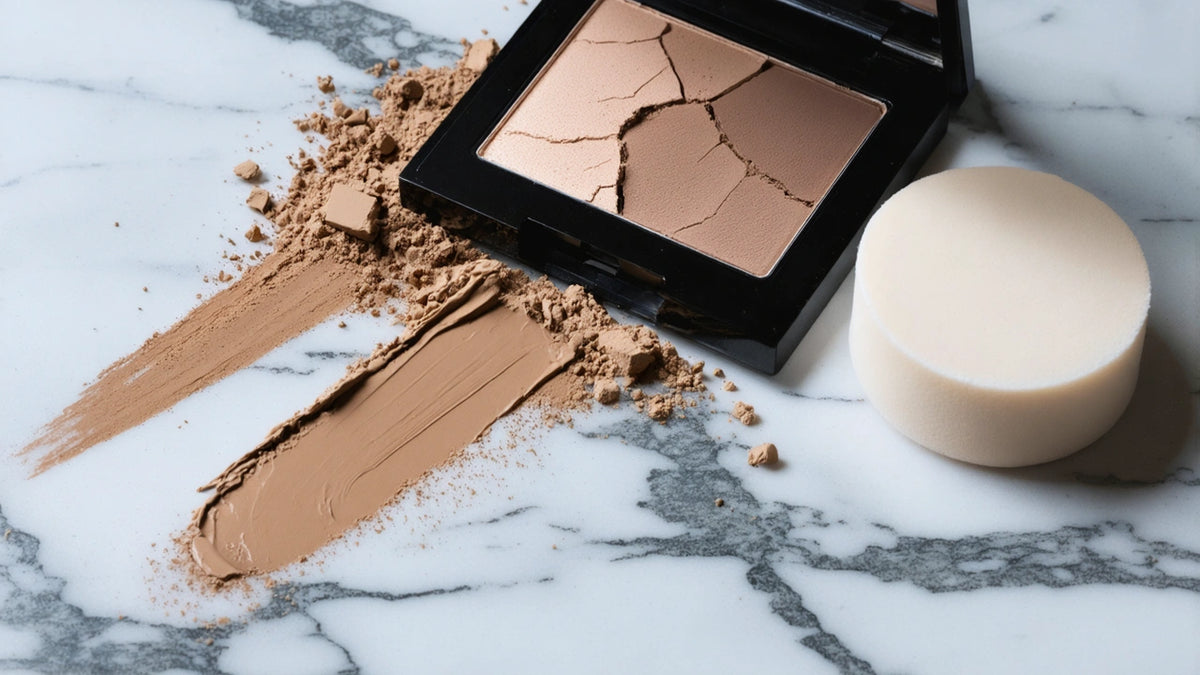
Kaolin clay in makeup is a fine, absorbent clay that soaks up excess sebum, which is why kaolin-based compacts hold a base in place through Indian humidity. Instead of sitting on top and sliding, the clay draws up surface oil as your skin produces it, so foundation stays put and shine takes far longer to break through.
A fine, gentle clay
Kaolin (INCI: Kaolin) is a naturally occurring aluminium silicate clay, historically called China clay. In cosmetics it's prized for being soft and finely milled — it has a slippery, almost silky feel between the fingers rather than a gritty one. That texture is why it works so well in pressed powders: it presses into a smooth cake, picks up cleanly on a sponge, and diffuses over skin without dragging.
How it absorbs sebum
The mechanism is physical, not medical. Clay particles have a large surface area relative to their size, so when sebum reaches the skin's surface it gets taken up into and around those particles instead of pooling into a slick. That's the whole game in humid weather: your skin is producing oil faster, and the air is too saturated for sweat to evaporate quickly, so anything sitting on top of your base starts to move. An absorbent powder interrupts that cycle. It doesn't stop your skin from doing its job — it just manages the output so your makeup doesn't pay the price.
Why the finish stays soft
A well-built kaolin compact isn't only clay. It's balanced with emollients and conditioning agents so the powder blurs texture without looking dusty. This matters more in India than most global formulations account for: our skin is often oily in the T-zone and dehydrated on the cheeks at the same time, especially if you're moving between AC offices and 34°C streets. A powder that's purely absorbent will cling to the dry patches. A powder that's absorbent and conditioned settles evenly on both.
Kaolin vs Talc vs Silica: Which Shine Control Ingredient Wins?
All three are legitimate powder ingredients that do slightly different jobs. Knowing which one you're buying tells you how your compact will behave at hour six.
| Ingredient | Primary job | Feel on skin | Best for |
|---|---|---|---|
| Kaolin clay | Absorbs surface oil and moisture | Soft, dry-touch, slightly velvety | Oily and combination skin in humid cities |
| Talc | Bulking and slip; mild absorbency | Silky, easy to blend, very smooth | Even application and a lightweight pressed cake |
| Silica | Blurring and light diffusion; also absorbent | Cushiony, soft-focus, near-weightless | Softening pores and texture, photo finish |
Absorption vs blurring
Silica is a brilliant blurrer — it scatters light so pores and fine lines read softer. But blurring and absorbing aren't the same promise. If your core problem is a forehead that goes reflective 90 minutes after you leave home, absorption is what you actually need. Kaolin leads on that. Many good formulas use both, which is why reading an ingredient list beats guessing from the packaging. Our longer breakdown of a translucent setting powder for oily skin in India goes deeper into how absorption and diffusion split the work.
Feel on skin
Talc-containing powders tend to feel the silkiest going on because talc gives slip. Kaolin-forward powders feel drier to the touch — a "grippy-matte" finish that holds. Neither is better in the abstract; it depends on whether you want your powder to disappear or to work.
Best pick for Indian humidity
For monsoon Mumbai, coastal Chennai or a Delhi September, a kaolin-forward compact is the more reliable bet. If you also want sun protection layered into your touch-up, the Dream Cover SPF15 Mattifying Compact Powder gives you mattifying coverage with SPF 15 in the pan — useful, though a compact is a top-up, never a replacement for your morning sunscreen.

Why Does a Vitamin E Compact Not Look Chalky on Deeper Skin Tones?
Here's the honest problem with a lot of powder: it can throw a grey or ashy cast, and that cast is far more visible on medium-to-deep skin than on fair skin. It's a light-scattering issue. Very high loads of white absorbent and filler powders reflect light back in a way that can look dusty against deeper undertones — the infamous "why is my forehead a different colour to my neck" moment.
Comfort on medium and deep tones
Vitamin E (INCI: Tocopheryl Acetate) is used in cosmetics as a conditioning agent and antioxidant that helps keep a formula feeling comfortable rather than tight. In a pressed powder, that conditioning matters twice over: it softens the dry-touch feel of clay, and it helps the powder sit as a thin, even veil instead of a chalky layer. Most Indian skin sits in the Fitzpatrick III–V range with warm, golden or olive undertones, which is precisely where an under-conditioned powder shows up worst — so a Vitamin E compact is less of a luxury and more of a requirement.
Powder that photographs well
Flash is the real test. If a powder is too heavily loaded with reflective particles, flash photography bounces off it and you get a pale mask across the T-zone. The fix isn't skipping powder — it's using less of it, pressing it only where you shine, and choosing a compact whose finish leans soft-matte rather than flat-matte. And build it over a base that already matches you: set the Ace Of Face Foundation Stick with the lightest possible dust of powder and you'll photograph like skin, not like a filter.

How Should You Apply an Oil Absorbing Powder in India? Press, Don't Sweep
Ninety percent of cakey powder is technique, not formula. Sweeping a brush across your face moves your foundation around and deposits product where you don't need it. Pressing sets it. Here's the sequence that survives a Mumbai local commute.
- Step one — T-zone first. Load a damp-free sponge, press it flat into the pan once, tap off the excess, then press — nose, forehead centre, chin. These are the areas with the most active oil, and they earn the powder.
- Step two — cheeks last, and barely. Whatever product is left on the sponge after the T-zone is exactly the right amount for your cheeks. Do not reload. This single rule prevents most flashback.
- Step three — leave the under-eye alone until you've smiled. Press powder under the eyes only where concealer actually creases, and check it with a smile before you commit.
- Step four — blot before you re-powder. Powder on top of oil turns into paste. Blot the shine off with tissue or blotting paper first, then press fresh powder into the clean surface. This is the step everyone skips and the reason midday touch-ups look worse than the original.
- Step five — for festive nights, touch up in thirds. Nose only at hour three. Nose and forehead at hour six. Full T-zone if you're going past hour eight. Layering in thirds keeps a nine-hour night looking like hour one.
The same press-don't-sweep logic underpins every long-day base — we've spelled out the full routine in our guide to sweat-proof makeup tricks for Indian summer heat, and if you're specifically shopping rather than troubleshooting, start with our pick of the best compact powder for oily skin in humid India. Pro tip for monsoon season: pair a kaolin compact with waterproof eye makeup for rainy, humid days so the whole face holds, not just the base.
What about a 20 hr longwear compact — is that realistic?
A 20 hr longwear compact claim refers to how long the powder itself is designed to hold its finish, not a promise that you'll never blot. Real-world wear depends on your skin's oil production, the weather, your base underneath and whether you're eating three meals in between. Treat the number as an indicator of formula intent — then use technique to get the most out of it.
Frequently Asked Questions About kaolin clay makeup for humid weather
What does kaolin clay do in makeup?
Kaolin clay works as a natural oil-absorber and mattifier in makeup, soaking up excess sebum without stripping the skin of moisture. Because it's a fine, gentle mineral clay, it sits smoothly on the skin instead of sitting in a visible layer, which helps powders and compacts blur pores and control shine through the day. It's especially useful in humid weather because it keeps absorbing oil as your skin produces more of it, rather than breaking down or sliding off like some synthetic fillers can
Is kaolin clay good for oily skin in humidity?
Yes, kaolin clay is generally well-suited to oily skin in humid conditions because of its high oil-absorbing capacity. In humid climates, oily skin tends to produce more sebum, which can cause makeup to slide, separate, or look patchy by midday. Kaolin clay helps counter this by continuously drawing out excess oil, keeping the surface matte-looking for longer. It's also considered gentle enough for regular use, since it doesn't clog pores the way heavier, greasy bases can, making it a practical
How is kaolin clay different from silica in powders?
Kaolin clay and silica both control shine, but they work differently: kaolin absorbs oil and moisture like a sponge, while silica mainly scatters light and creates a soft-focus, blurred effect on the skin. Silica is often prized for its smooth, silky texture and its ability to fill in fine lines or pores visually, but it doesn't absorb as much oil as kaolin does. Many powder formulas combine both, using kaolin for oil control and silica for the airbrushed finish, so you get mattification without
Does kaolin clay compact look cakey on deeper skin tones?
Not if it's formulated well — a good kaolin clay compact shouldn't look cakey or ashy on deeper skin tones, since the clay itself is finely milled and doesn't sit as a thick, opaque layer. Cakiness on deeper skin usually comes from products with too much white cast pigment, poor blending, or over-application rather than the clay ingredient itself. Choosing a compact with a wide, well-matched shade range and applying it in thin, buildable layers helps avoid a chalky finish, letting the natural de
How long does kaolin clay makeup take to control shine once applied?
Kaolin clay starts absorbing surface oil almost immediately after application, but its full mattifying effect usually becomes noticeable within the first 15 to 30 minutes as it settles and soaks up initial shine. In humid weather, it continues working throughout the day, absorbing oil as it resurfaces rather than giving a one-time effect. This is different from primers that create a temporary barrier, since kaolin actively manages oil on an ongoing basis, which is why it tends to hold up better
Shop SUGAR Cosmetics
Ready to stop fighting your own T-zone? Grab the SUGAR POP 20 HR Longwear compact with Kaolin Clay and Vitamin E — kaolin for oil control, Vitamin E so the finish stays soft on Indian skin tones, and a size that fits every handbag. Swatch shades, compare finishes and read real reviews on sugarcosmetics.com. Cruelty-free, made for Indian weather, priced so beginners can start without overthinking it.