
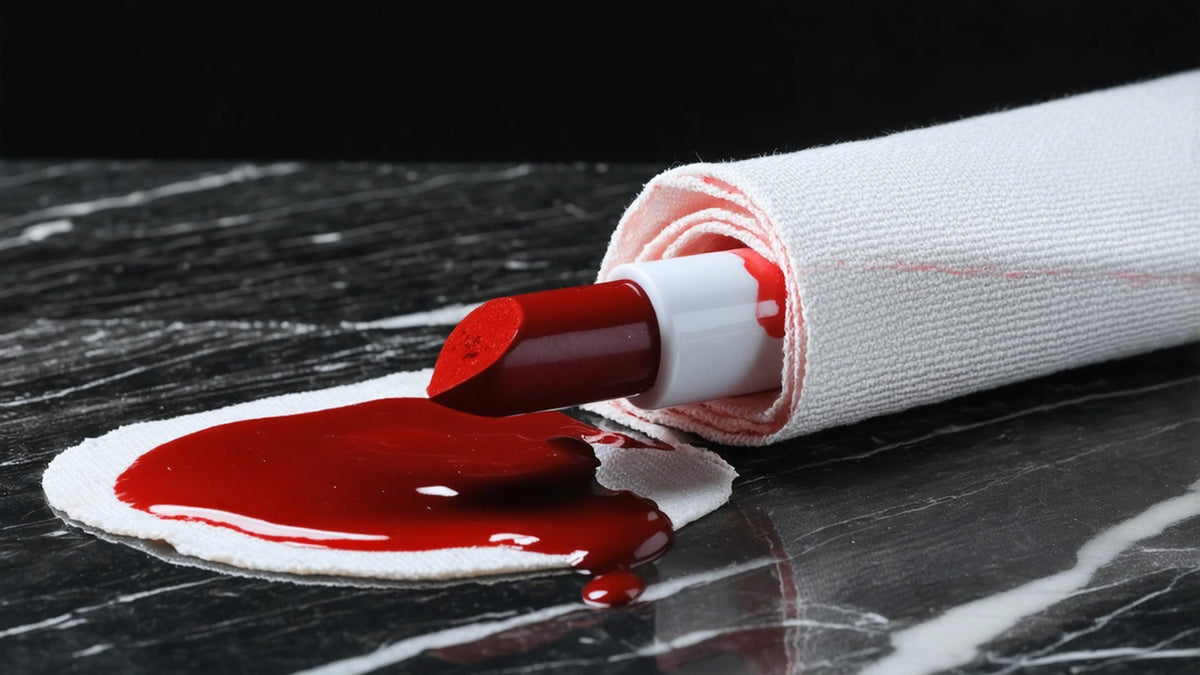
A transferproof lipstick for face mask days is a lip colour that dries down into a thin, flexible matte film that grips your lips instead of your mask, your chai cup or your dupatta. If you've ever pulled down a mask mid-metro and found a perfect lip print staring back at you, this is the fix. The formula is built to set rather than stay wet, so the pigment stops migrating the second it dries — which is exactly why mask-proof lipstick in India has become less of a trend and more of a survival skill.

Why Does Lipstick Transfer Onto Masks, And What Solves It?
Transfer happens for one boring reason: the lipstick never finished drying. Most comfortable, creamy bullets are built on emollients and waxes that stay semi-fluid on the lip surface so they feel cushiony all day. Lovely for dry weather. Less lovely when a cotton mask presses against that soft layer for forty minutes on a crowded bus.
Why creamy formulas transfer
Creams keep a mobile oil phase sitting on top of your lips. Fabric is absorbent and slightly abrasive, so it lifts that oil phase — and the pigment suspended in it — straight off. Add Indian humidity, which slows evaporation, and a satin bullet can stay tacky far longer than you'd expect. It's not a bad lipstick. It's just the wrong tool for a mask day.
What 'transferproof' actually means
Transferproof does not mean indestructible. It means the formula is designed so that once the volatile carriers evaporate, what's left behind is a set film with high pigment and low free oil. That film resists rubbing, blotting and light friction. Oil still breaks it down, which is why a paratha makes more of a dent than a mask ever will. Our Ultrastay Transferproof Lipstick is built around exactly that logic — pigment first, slip later.
What Makes Ultrastay Transferproof Lipstick Stay Put?
Here's the cosmetic-chemistry-lite version, without any invented numbers.
Liquid-to-matte film
Liquid lipsticks apply wet because pigment is dispersed in volatile carriers that evaporate at skin temperature. As they leave, film formers knit the pigment into a continuous, thin layer that moves with your lips. That's the whole trick. The wetter it looks, the less set it is — so the ten seconds you spend resisting the urge to press your lips together are the ten seconds doing all the work.
Pigment load vs oil content
There's a straightforward trade-off in lip formulation: more free oil means more comfort and more transfer; more pigment and film former means more opacity and less transfer. Transferproof formulas sit firmly on the low-oil end. That's why one coat of a good matte liquid covers what three coats of a sheer balm can't, and why the colour looks the same at 6pm as it did at 9am.

Comfort without slip
Low oil doesn't have to mean sandpaper. Conditioning agents and emollient esters can be included in a way that softens the feel of the film without keeping it fluid, and Vitamin E is a long-established cosmetic ingredient used in lip products for its antioxidant and conditioning role in the formula itself. The goal is a lipstick you forget you're wearing — not one you're constantly aware of.
Every SUGAR formula is cruelty-free, and the Ultrastay range was developed with Indian wear conditions in the brief: humidity, long commutes, air-conditioned offices, and the specific chaos of a working day that includes at least two cups of tea. If you want the wider story of how we stress-test long-wear makeup for this climate, our weather-tested long-wear approach covers it, and our deep dive on how liquid lipstick holds up across a 12-hour Indian day shows the same principles in action.
How Do You Apply Transferproof Lipstick? The Blot-Set-Blot Method
A transferproof lipstick sets into a thin matte film that resists rubbing off on masks, cups and fabric. Apply two thin coats, blot between them, and let each layer set for 60 seconds for the least transfer. Skipping the blot leaves loose pigment on the surface, which is the layer that prints onto your mask.
Step 1: Prep lips with balm, then blot it off
Prep and remove the shine. Smooth on a thin layer of Nourishing Lip Balm, wait two minutes, then press a tissue firmly over your lips. You want softness left behind, not slip. A greasy base is the single most common reason a transferproof formula fails — the film can't grip an oily surface, so it slides into lines and lifts onto fabric.
Step 2: Two thin coats, not one thick one
Build in layers. Apply coat one from the centre outwards, staying just inside your natural lip line. Let it dry for a full 60 seconds without pressing your lips together. Then blot lightly with tissue and add coat two, this time taking colour right to the edges. Two thin coats set faster and flex better than one heavy one, which stays tacky in the middle and cracks at the corners.
Step 3: The tissue-and-powder lock
Seal the surface. Place a single-ply tissue over your lips and dust the lightest whisper of translucent powder through it — the SUGAR POP 20 HR Longwear compact with Kaolin Clay and Vitamin E works because kaolin clay is widely used in cosmetics for its oil-absorbing properties. This mops up any last surface moisture so the film is genuinely dry before your mask goes on.
Step 4: Wait before masking up
Give it three minutes. Do your kajal, find your keys, reply to one message. Three minutes between final coat and mask contact is the difference between a clean mask and a smudged one. For commute days when you're applying in a moving auto, a bullet like the Matte As Hell Crayon Lipstick is the smarter choice — one swipe, no drying window, no mirror gymnastics.
Wear Test: How Does No Smudge Lipstick Survive One Indian Workday?
We wore a deep brick Ultrastay shade through a standard Mumbai-to-office-and-back day, mask on for all public transport, and noted what actually happened. Honest results, touch-ups included.
| Time | What happened | Mask / cup transfer | Touch-up needed? |
|---|---|---|---|
| 9:00am | Metro, mask on for 35 minutes, 78% humidity | None visible on the inner mask fabric | No |
| 11:30am | Two glasses of water, one long call | Clean glass rim | No |
| 1:00pm | Thali lunch — dal, ghee roti, achaar | Slight lightening in the centre of the lower lip | Yes, one quick centre-only coat |
| 4:00pm | Cutting chai, glass tumbler, hot | Faint warmth-softened edge, no ring on the glass | No |
| 7:00pm | Late meeting, group selfie | Colour reading true, slightly flatter finish | Optional gloss on top |
The honest verdict
Masks and chai were genuinely non-events. Oil was the only real opponent — a ghee-heavy thali will always thin the centre of any matte lip, and pretending otherwise would be nonsense. The fix took eleven seconds: blot, one thin coat in the middle only, done. By 7pm the finish had gone from velvet to flat, which is when a touch of shine helps rather than hurts.
If your day involves more outdoor heat than air conditioning, our summer and humidity guide to long-lasting lipstick goes deeper on how high temperatures change wear time. And because eyes have the same friction problem above the mask line, the same set-then-seal logic applies to keeping kajal from smudging on oily eyelids.
Which Lipstick Shades Hide Transfer Best On Indian Skin Tones?
Here's the strategic bit nobody tells you: some shades forgive residue and some announce it. Indian skin most often falls in the Fitzpatrick III to V range, with warm golden and olive undertones, which means earth-toned lips read as intentional rather than leftover even after a meal.
Warm beige and caramel nudes
The lowest-maintenance option. Because these shades sit close to warm lip and skin undertones, any faint edge softening looks like a blurred lip, not a mistake. On fair-to-light-medium tones, look for beige with a peach lean; on medium to deep tones, caramel, toffee and cocoa-nude read far more flattering than pinkish nudes, which can go grey.
Brick and terracotta
The workday MVP. Brick, rust and terracotta have enough brown in the base that they fade gracefully into a stain rather than a patch. They also happen to be the most photogenic family under Indian office lighting and yellow-toned tube lights.
Deep berry and wine for evenings
High drama, slightly higher upkeep. Deep berry and wine show their fade line more clearly, so line the lips fully in the same shade before filling in — that way a centre fade still looks like a deliberate ombré. Gorgeous on deeper tones especially, where plum undertones sing against warm depth.
The residue-proof rule
Ask yourself one question: if 20% of this wore off, would it still look like a lip colour? Earthy browns, bricks and caramels say yes. Bright fuchsia and true orange-red say maybe not. Choose accordingly on mask-heavy days, and save the brights for dinners where you can touch up.
What Else Belongs In A Mask-Proof Lip Routine?
Shine is not the enemy of transferproof — it just has to be engineered for it. A Partner In Shine Transferproof Lip Gloss over a set matte base gives you evening dimension without turning your lip into a sticker. For a fuller toolkit of layering, lining and locking techniques, our long-wear matte lipstick playbook is the natural next read.
- Keep one tissue in your bag — blotting before a touch-up matters more than the touch-up itself, because fresh colour won't bond to a wet lip.
- Drink from the same side of the glass — a small habit that keeps wear even instead of patchy on one side.
- Choose cotton masks over synthetic when you can; smoother fabric means less abrasion against the film.
- Don't reapply balm midday over a matte lip. It dissolves the film you worked for. Prep in the morning, then leave it alone.
Frequently Asked Questions About transferproof lipstick for face mask days
Which lipstick does not transfer on masks?
A transferproof lipstick for face mask days uses a lightweight liquid-to-matte formula that grips onto the lips instead of sitting on the surface, so it doesn't rub off on fabric. Look for terms like 'transferproof' or 'ultrastay' on the label, since these formulas dry down to a weightless film. Regular creamy or glossy bullet lipsticks almost always leave marks on masks because they stay slightly wet and shift with friction throughout the day.
How do you make any lipstick transferproof?
You can boost transfer-resistance by prepping bare lips with a tissue-off primer layer, applying colour, blotting with a tissue, then dusting a light layer of translucent powder over the lips before a final coat. This creates a dry, matte surface that resists rubbing off on masks, cups, or food. While this hack helps regular lipsticks last longer, dedicated transferproof formulas are still more reliable since they're built with polymers designed specifically to resist smudging without needing ex
Does transferproof lipstick dry out lips?
Transferproof lipsticks can feel more drying than glossy formulas because they rely on quick-setting, film-forming ingredients rather than oils or emollients. However, well-formulated versions balance this with hydrating agents so lips don't feel tight or flaky. To keep lips comfortable through a full mask-wearing day, exfoliate lips beforehand and apply a hydrating lip balm as a base layer before your transferproof lipstick, and reapply balm at night to restore moisture lost during the day.
How do you remove transferproof lipstick?
Transferproof lipstick needs an oil-based makeup remover or micellar water since water and soap alone won't break down its long-wear film. Soak a cotton pad in remover, press it onto lips for a few seconds to let it dissolve the formula, then wipe gently in one direction instead of rubbing. Follow up with a hydrating lip balm afterward, since the removal process combined with a long day of wear can leave lips feeling slightly dry.
What is the difference between transferproof and long-lasting lipstick?
Long-lasting lipstick focuses on colour staying vibrant for hours, but it can still leave marks on masks, cups, or clothes since it hasn't fully set. Transferproof lipstick, on the other hand, is specifically engineered to dry into a smudge-resistant film that won't rub off on surfaces it touches, even if worn for a shorter time. For mask days, transferproof matters more than sheer longevity because the concern is friction and contact, not just colour fading.
Can I eat and drink comfortably with transferproof lipstick on?
Yes, transferproof lipsticks are designed to withstand contact with cups, cutlery, and food without smearing or fading significantly. The film-forming formula sets on the lips and resists the friction and moisture from eating chai or a meal far better than regular lipsticks. That said, very oily or greasy foods can still cause some fading over time, so a quick touch-up after a heavy meal will keep the colour looking fresh through a long workday.
Shop SUGAR Cosmetics
Ready for a lip colour that stays on your face and off your mask? Start with the Ultrastay Transferproof Lipstick in a brick or caramel shade if you're commuting daily, and add the Glide Peptide Serum Lipstick for the days you want comfort over combat. New to mattes and watching your budget? The SUGAR POP range is the friendliest place to start. Swatch the full shade spread across fair to deep tones on sugarcosmetics.com and find your no-transfer match.