

Finding your perfect sugar foundation shades match starts with one truth: Indian skin refuses to fit into a three-shade global beauty box. SUGAR foundation shades are a dedicated complexion-matching system built specifically for Indian undertones — warm, olive, neutral, and deep-dusky — across the W (wheatish), M (medium-golden), and D (deep-dusky) categories. If you have ever walked out of a beauty aisle holding a foundation that turned grey by lunchtime or oxidised two tones darker by dinner, this guide fixes that for good. For a deeper visual breakdown, our SUGAR foundation shade guide — find your perfect match works as a companion read alongside this one.
To find your SUGAR foundation shade for Indian skin: first identify your undertone (warm, cool, or neutral) using the vein test, then choose from SUGAR's W (wheatish), M (medium-golden), or D (deep-dusky) shade categories. For oily skin, choose the Ace of Face Foundation Stick; for dry skin, the Ace of Face Dewy Foundation. Match along your jawline, never your hand, for true accuracy.
Why Foundation Shade Matching Is Harder (and More Important) for Indian Skin
Indian skin is a spectrum, not a category. A woman in Kerala, another in Kashmir, and one in Kolkata could share the same Fitzpatrick rating yet need three completely different foundations because their undertones run warm-golden, cool-pink, and olive-neutral respectively. Global beauty brands have spent decades treating "medium" as a single shade — and Indian women have spent those same decades looking ashy, orange, or chalky in their wedding photos.
The warm, olive, and deep-dusky undertone problem
The biggest miss in international foundation ranges? Olive undertones. Olive skin carries green-grey pigment beneath warm yellow, and most foundations only swing between pink-cool or peach-warm — leaving olive complexions sitting in a no-man's-land that reads sallow on camera. Deep-dusky skin faces a different challenge: brands often add too much red oxide pigment, making rich brown skin look muddy instead of luminous. SUGAR's shade development begins with these gaps, not after them.
Why Fitzpatrick III–V skin needs dedicated shade development
Research published in the Indian Journal of Dermatology found that over 65% of Indian skin falls between Fitzpatrick types IV and V, with significant variation in melanin distribution even within the same face. Dermatologists recommend choosing foundation based on the jawline (not the wrist or hand) because hands oxidise differently from facial skin due to sun exposure. SUGAR's range maps directly onto this melanin reality: every shade is tested under Indian daylight, not studio lighting.
How SUGAR built its shade range for Indian complexions
The SUGAR Cosmetics Method for shade development uses a three-axis system: depth (light to deep), undertone (warm, cool, neutral, olive), and finish (matte to dewy). Each foundation is formulated with iron oxide blends adjusted for Indian melanin so it neither oxidises orange in humidity nor pulls grey under flash. This is why a SUGAR shade labelled "Cappuccino" looks like cappuccino on actual Indian skin — not on a Pantone chip.
Understand Your Undertone First: Warm, Cool & Neutral for Indian Skin
Before you obsess over depth, fix your undertone. Undertone is the unchanging hue beneath your surface skin colour — it stays the same whether you tan in Goa or pale through a Delhi winter. Get this wrong and even the right depth will look "off."
The vein test and other undertone-finding methods
Flip your wrist to natural daylight (not yellow tube light) and look at the veins on your inner wrist. Green veins signal warm undertones, blue or purple veins signal cool, and a mix of both signals neutral. A second cross-check: hold a piece of white paper next to your bare face. If your skin looks yellow-golden against the white, you are warm. If it looks pink-rosy, you are cool. If it looks olive-grey, you are neutral-olive.
Warm undertones: the most common Indian skin type
Roughly 70% of Indian women carry warm or warm-neutral undertones, leaning yellow, golden, peach, or honey. This is why most SUGAR shades — the entire W and M families — are built on a warm base. If gold jewellery suits you better than silver, you are almost certainly warm.
Cool and neutral undertones in Indian complexions
Cool undertones do exist in Indian skin, especially in North-East and Himalayan regions, presenting as pink-rosy or porcelain. Neutral undertones balance both and have the easiest time shade-matching. Olive undertones — common across South and Western India — sit in their own category and look best in shades with a slight green-yellow tilt.
SUGAR Foundation Formats: Which One Is Right for Your Skin?
Once your undertone is locked in, your skin type decides the format. SUGAR offers three serious contenders, each engineered for a specific Indian skin reality.
Ace of Face Foundation Stick: full coverage, oily skin hero
The Ace of Face Foundation Stick is a 12HR matte, transfer-proof, full-coverage stick built for oily and combination skin. The waxy-powder formula contains kaolin clay and silica microspheres that absorb sebum across the T-zone without flattening your face into a mask. It runs in 16 inclusive shades from fair-warm to deep-dusky, and the bullet format lets you spot-conceal where you want more coverage and sheer out where you want less. For Mumbai humidity or Chennai heat, this is the no-budge pick.

Ace of Face Dewy Foundation: hydration-first for dry skin
The Ace of Face Dewy Foundation flips the script for dry, dehydrated, and mature skin. Formulated with hyaluronic acid (sodium hyaluronate, INCI) and glycerin, it pulls moisture into the skin while delivering medium-buildable coverage with a lit-from-within glow. It survives 12 hours without sliding because the polymer film lets skin breathe and reflect light rather than going greasy. Dry skin in over-conditioned offices and AC-blasted flights drinks this up.
Lightweight liquid base: second-skin finish for everyday wear
If you want barely-there coverage with a natural-skin finish, SUGAR's lightweight liquid bases like Matte Match Transferproof Foundation work like a second skin — buildable, undetectable, and breathable enough for daily wear. Cosmetic scientists note that lightweight foundations with high water-phase content sit better on Indian skin than heavy occlusive formulas because they let melanin's natural luminosity show through. For office, college, brunch, or "I have to look alive but not made-up" days, this is the format.
| Format | Best For | Coverage | Finish | Wear Time |
|---|---|---|---|---|
| Ace of Face Stick | Oily, combination | Full | Matte | 12HR transfer-proof |
| Ace of Face Dewy | Dry, mature | Medium buildable | Dewy glow | 12HR hydrating |
| Matte Match Liquid | Normal, daily wear | Light to medium | Natural matte | 12HR transfer-proof |
The Complete SUGAR Shade Guide by Indian Skin Tone
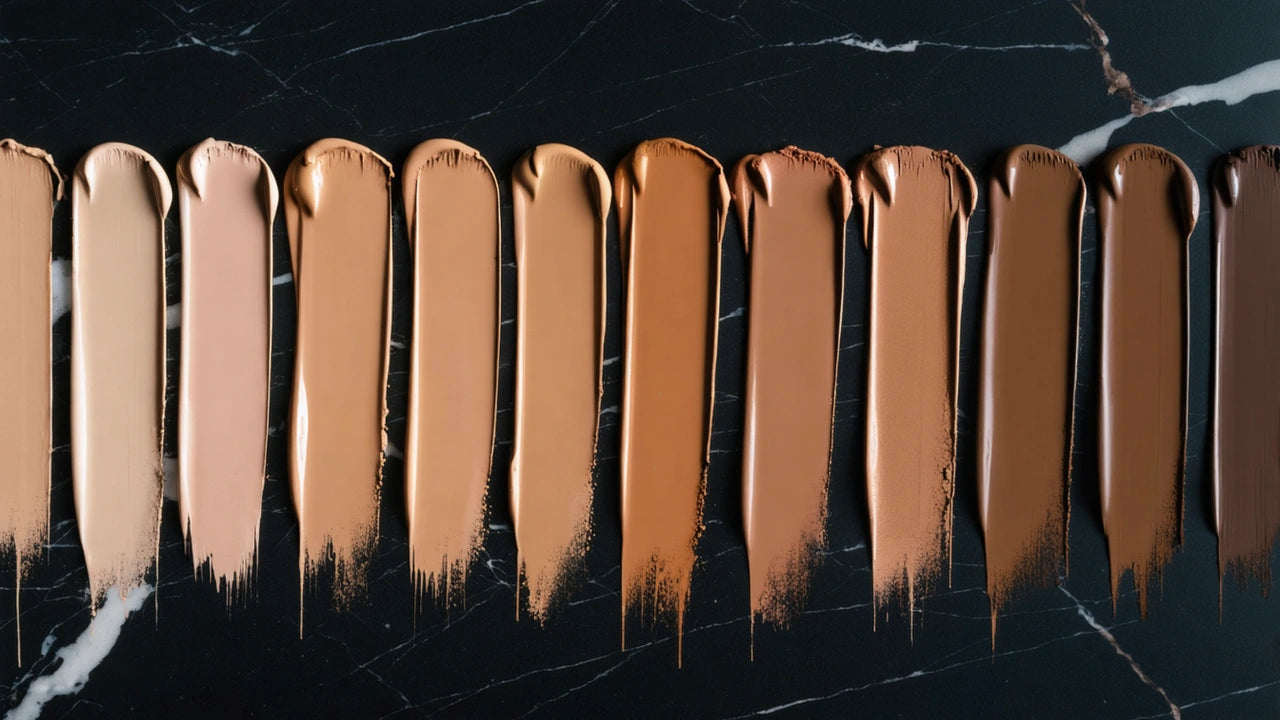
Here is the part you actually came for. SUGAR's shade architecture runs across three depth families, each split into warm and neutral options. Match along your jawline in natural daylight and let the foundation sit for 60 seconds before deciding — oxidation is real.
Fair to wheatish shades: W1–W3 range
The W family covers fair-to-wheatish Indian complexions (think shades like Ivory Cream, Latte Spice, and Honey Macchiato). W1 suits the lightest warm-Indian skin with golden undertones, W2 lands on classic wheatish-warm, and W3 bridges into light-medium territory. If your face tans easily in two days of sun but your décolletage stays fair, choose W2 for the face and keep W3 for summer.
Medium to golden-olive shades: M1–M3 range
The M family handles medium-golden, olive, and warm-neutral skin — the largest segment of Indian complexions. M1 (Caramel Frappe types) works for medium-warm, M2 (Cappuccino) lands on classic golden-olive Indian skin, and M3 (Toffee Blend) sits at the edge before deep territory. Olive undertones should always test M2 first; it carries the green-yellow tilt that neutralises sallowness.
Deep, dusky & rich complexion shades: D1–D3 range
The D family is where SUGAR refuses to skimp — D1 through D3 cover deep, dusky, and rich complexions with proper red-brown and golden-brown undertone variation, not just darker versions of medium shades. D1 suits deep-warm, D2 hits rich-brown with red-mahogany undertones, and D3 is built for the deepest Indian complexions with cool-brown depth. The pigment load uses true brown iron oxides instead of grey-black fillers, so the finish stays luminous.
How to blend two shades for a custom match
If you sit between two SUGAR shades (very common — Indian skin rarely matches a single bottle), buy both and mix on the back of your hand before applying. Use a heavier ratio of your "winter shade" in cooler months and shift to the deeper one post-Holi or post-beach. Dabbing a touch of Ace of Face Dewy Foundation in 15 Cappuccino into a slightly fairer matte base also adds glow without changing the depth.
How to Apply SUGAR Foundation for Flawless Indian Skin
Application makes or breaks even the perfect shade match. The right tool decides whether your foundation looks airbrushed or cakey.
Tools: brush vs sponge vs fingers
A Blend Trend Foundation Brush Kabuki delivers the most uniform full-coverage finish because the dense bristles buff product into the skin rather than dragging it across. A damp sponge sheers things out for a dewier, lighter look. Fingers work for stick formulas in a pinch because body heat melts the wax for better blending — but always finish with a brush to remove streaks.
Primer first: why it matters more in summer
Primer creates the grip layer that holds foundation in place for 12 hours. The Aquaholic Priming Moisturizer hydrates and primes in one step for dry skin, while silicone-based primers are non-negotiable for oily T-zones in monsoon. For a deeper dive, our primer guide for oily Indian skin breaks down the science.
Setting the foundation for 12HR wear in Indian heat
Set with a translucent powder pressed (not swept) into the T-zone, then mist with a hydrating spray to melt the powder into the skin. This single step adds hours of wear and kills the "caked face" effect.
Foundation for Specific Indian Skin Concerns
Foundation does not work in isolation — it works with your skin's specific story.

Oily and acne-prone skin: matte stick formula
Oily skin needs sebum control without dehydration. The Ace of Face Stick's kaolin-silica blend absorbs oil while staying breathable, and the bullet format means zero fingers touching active breakouts — which matters for acne hygiene.
Dry skin in Indian AC-heavy environments
Layer the Aquaholic Priming Moisturizer under the Dewy Foundation. The humectants pull water into the upper epidermis and lock it in, fighting the moisture-stripping effect of office air-conditioning that leaves dry skin looking flaky by 3 pm.
Dark spots and hyperpigmentation coverage tips
Indian skin is melanin-rich, which means hyperpigmentation, melasma, and post-acne marks show up easily. Foundation alone rarely covers deep pigmentation — pair it with a colour-correcting concealer in peach or orange to neutralise dark spots before applying foundation on top. Our SUGAR concealer shade guide for Indian skin shows you exactly how to layer for full coverage without cakiness.
Frequently Asked Questions About sugar foundation shades
How many shades does SUGAR foundation come in?
SUGAR foundation ranges typically come in 15 to 25 shades depending on the formula, spanning fair, light, medium, tan, and deep skin tones with warm, cool, and neutral undertones. For example, the Ace Of Face Foundation Stick offers a wide shade library built specifically with Indian skin in mind, while liquid formulas like Dream Cover and Drop The Base each carry their own shade families. Always check the specific product page for the exact count, since SUGAR keeps expanding its inclusive shade
Does SUGAR foundation cover dark spots and pigmentation?
Yes, SUGAR offers full-coverage foundations like Ace Of Face and Drop The Base that effectively camouflage dark spots, acne marks, and pigmentation in one to two layers. For stubborn pigmentation common on Indian skin, build coverage gradually with a damp sponge and spot-conceal afterwards with a matching SUGAR concealer. Medium-coverage options like Dream Cover blur minor spots while keeping a natural skin-like finish. Pair with a colour corrector underneath if you're tackling deep melasma or u
Which SUGAR foundation is best for oily skin in Indian summers?
The SUGAR Ace Of Face Foundation Stick and Drop The Base Weightless Serum Foundation are the top picks for oily skin in Indian summers, thanks to their matte, sweat-resistant, transfer-proof finish. Both formulas control shine for up to 12 hours and resist humidity, making them ideal for Mumbai, Chennai, or Kolkata weather. Set with a translucent powder in the T-zone for extra staying power. Skip dewy formulas like luminous tints during peak summer if you tend to get oily by midday.
How do I find my SUGAR foundation shade online without testing in store?
To find your SUGAR foundation shade online, first identify your undertone by checking your wrist veins — green means warm, blue/purple means cool, and a mix means neutral. Then match your depth level (fair, light, medium, tan, deep) to SUGAR's shade chart on the product page. Use SUGAR's virtual try-on tool or take the online shade quiz for a personalised recommendation. When in doubt, order two adjacent shades — you can mix them or use the lighter one for winter and deeper one for summer.
What is the difference between SUGAR Ace Of Face and Drop The Base foundation?
SUGAR Ace Of Face is a full-coverage matte foundation stick designed for long wear and heavy pigmentation cover, while Drop The Base is a lightweight serum foundation offering medium, skin-like coverage with skincare benefits. Ace Of Face suits oily skin and special occasions where you want flawless, photo-ready finish. Drop The Base works better for daily wear, dry-to-normal skin, and those who prefer a natural, breathable feel. Both come in inclusive Indian skin tone shades but cater to opposi
Can I use SUGAR foundation with sunscreen and moisturiser?
Absolutely — SUGAR foundation layers beautifully over moisturiser and sunscreen when applied in the right order. Start with moisturiser, wait two minutes, apply broad-spectrum SPF 30+ sunscreen, let it set for another three to five minutes, then apply your SUGAR foundation. This prep prevents pilling, balling, or patchiness — common issues in Indian humidity. For oily skin, choose a gel moisturiser and matte sunscreen; for dry skin, go richer underneath. Always finish with a setting spray to loc
Shop SUGAR Cosmetics
Your perfect shade is not a guessing game — it is a system. If you are oily, combination, or live anywhere south of Delhi, lock in the Ace of Face Foundation Stick for 12HR transfer-proof matte coverage. If your skin runs dry, drinks moisturiser like water, or you just want that lit-from-within glow, the Ace of Face Dewy Foundation is your match. SUGAR builds for every shade of beautiful — wheatish, golden, olive, dusky, and deep — because Indian skin deserves more than one bottle pretending to fit all. Pick your format, match your undertone, and never settle for "close enough" again.