

SUGAR Foundation Shade Guide: Find Your Perfect Match for Indian Skin
Finding your perfect SUGAR foundation shade is not a guessing game — it is a science, and it starts with understanding your undertone. Foundation shade matching is the process of pairing a complexion product's depth and undertone to your own skin's pigmentation so the formula disappears into your face rather than sitting on top of it. For Indian women spanning Fitzpatrick skin types III through V — warm golden to rich deep brown — this process has historically been an afterthought in global beauty. SUGAR Cosmetics was built to fix exactly that. This guide covers everything: how to read your undertone, which SUGAR formula suits your skin concern, and the exact shade names that will make your complexion look like you, just better. For a broader look at picking the right foundation formula before you dive into shades, this complete foundation selection guide for Indian skin is a great starting point.
Why Foundation Shade Matching Is Harder (and More Important) for Indian Skin
Walk into any global beauty retailer and you will find thirty shades of porcelain and five shades of "dark." That maths does not work for a country where the majority of the population falls between medium-golden and deep-brown on the complexion scale. Indian skin — particularly Fitzpatrick types III, IV, and V, which dominate the subcontinent — has a distinct undertone signature that Western formulations routinely overlook, resulting in foundations that look ashy, too pink, or frankly ghostly in natural light.
The warm undertone reality of most Indian skin
Research published in the International Journal of Cosmetic Science has documented that South Asian skin contains higher concentrations of eumelanin relative to pheomelanin compared to East Asian or Northern European skin, which produces the characteristic warm-golden to warm-brown cast seen across most Indian complexions. In practical terms, this means a foundation with a cool or pink base will oxidise on Indian skin and turn noticeably grey or chalky within two hours of wear. A warm or olive-leaning base, on the other hand, melts in and mimics the skin's own tone. This is not a preference — it is melanin biology.
Why western shade systems miss Indian complexions
The traditional North American and European shade system was built around a pink-to-beige axis, with "darker" shades simply being deeper versions of those same pink-beige bases. Indian skin does not live on that axis. It lives on a golden-to-bronze axis, which means depth alone is not enough — the undertone also needs to shift warmer as the shade gets deeper. Western systems that simply add brown pigment to a pink base create foundations that look muddy on medium-brown Indian complexions and flat on deeper ones. Cosmetic scientists note that formulating for warm undertones requires a fundamentally different pigment blend — one that uses yellow iron oxides and warm-toned titanium dioxide ratios — rather than cooling the palette with pink or violet pigments.
How SUGAR's shade range was built for brown skin
The SUGAR Cosmetics Method starts with Indian complexions as the design brief, not as an add-on. Every shade in the SUGAR foundation range is calibrated against real Indian skin tone data, with warm and golden undertones baked into the base pigment before depth is layered on top. The result: names like Cappuccino, Caramel, Mocha, and Espresso that actually map to the warm-brown spectrum most Indian women live in. It is not representation as an afterthought — it is representation as the entire starting point.
Understanding Your Undertone: The Key to Perfect Foundation
Before you pick a shade number or scroll through a foundation page, you need one piece of information: your undertone. Undertone is the underlying hue that lives beneath your skin's surface pigmentation — and unlike your surface tone, it does not change with sun exposure, seasons, or breakouts. Getting this right is the single most impactful thing you can do for your foundation game.
Warm, cool, and neutral: what's your undertone?
Warm undertones have golden, peachy, or yellow hues beneath the surface. Cool undertones lean pink, red, or blue-violet. Neutral undertones sit in the middle — a mix of warm and cool with no obvious dominant hue. For Indian skin specifically, the vast majority of women fall into the warm or neutral-warm category. True cool undertones exist across Indian complexions but are less common, particularly in Southern, Western, and Eastern India where warmer complexions dominate.
Quick tests to find your undertone at home
- Vein test: Look at the veins on your inner wrist in natural daylight. Green or greenish-blue veins signal a warm undertone. Blue or purple veins indicate cool. A mix of both? You're neutral.
- White paper test: Hold a plain white sheet next to your bare face. If your skin looks yellowish or golden against the white, you're warm. If it looks pinkish or rosy, you're cool. If it looks neither, you're neutral.
- Jewellery test: Does gold jewellery make your skin glow? Warm undertone. Does silver look more flattering? Cool. Both look equally good? Neutral.
- Sun reaction: Indian skin with warm undertones tends to tan to a golden-brown in the sun rather than burning red — another warm undertone indicator.
How undertones shift across Indian skin tones (NC25–NC50+)
Here is where it gets nuanced. A fair-skinned Indian woman with a warm undertone (roughly equivalent to NC25-NC30 on global shade systems) needs a foundation that is light in depth but warm in base — not the peachy-pink formulas that dominate the fair end of most ranges. As depth increases into medium and dusky territory (NC35–NC45), the warmth often intensifies too, requiring deeper golden and caramel bases. At the deep end of the spectrum (NC50+), the undertone can lean toward a richer, neutral-warm brown. Matching both dimensions — depth and undertone — simultaneously is non-negotiable for a skin-true finish.
SUGAR Foundation Range Decoded: Which Formula Is Right for You?
Shade matching is only half the equation. The formula you choose determines how your skin looks, feels, and holds up through a 12-hour Mumbai monsoon or a Delhi summer afternoon. Here is SUGAR's foundation line-up broken down by skin concern, not just finish.
Ace Of Face Foundation Stick: coverage and portability
The Ace Of Face Foundation Stick is SUGAR's full-coverage workhorse. It delivers buildable, medium-to-full coverage in a twist-up stick format, making it the go-to for on-the-go touch-ups, travel kits, and anyone who wants precise application without a brush. The formula is transfer-proof and long-wearing, surviving heat, humidity, and the chaos of everyday Indian life. It is particularly suited to normal and combination skin types — the slightly drier texture of the stick format helps control shine without a separate mattifying step. For Indian skin dealing with uneven skin tone, post-acne marks, or the kind of stubborn hyperpigmentation that comes standard-issue with brown complexions, this stick lets you build coverage exactly where you need it without the cakey payoff of over-application.
Ace of Face Dewy Foundation: second-skin glow for dry skin
Dry and dehydrated skin types — especially common during North Indian winters and in air-conditioned offices year-round — need a foundation that adds luminosity rather than stripping what little moisture the skin holds. The Ace of Face Dewy Foundation in 15 Cappuccino delivers a second-skin, lit-from-within finish that reads as "your skin, but glowy" rather than heavy or cakey. The dewy formula contains skin-loving ingredients that maintain hydration levels throughout wear, and the Cappuccino shade is an ideal pick for medium-to-deep warm skin tones. Cosmetic scientists note that dewy-finish foundations typically use higher concentrations of humectants and lower levels of silica — which creates a breathable, reflective film that catches light the way naturally moisturised skin does.
Aquaholic Priming Moisturizer as a tinted base option
Not every day calls for full-foundation coverage. The Aquaholic Priming Moisturizer works double-duty as both a skin-prep step and a sheer tinted base for days when you want your skin to breathe. It primes the face for foundation application while simultaneously delivering intense hydration — making it particularly valuable for the Indian climate, where skin often cycles between dehydration and excess oil production depending on the season and region. Apply it alone for a bare-skin-but-better result, or layer it beneath your SUGAR foundation for 12-hour extended wear and a plumper, more pillowy skin surface.

Matching formula to skin concern: oily, dry, and combination
| Skin Type | Best SUGAR Formula | Key Benefit | Pro Tip |
|---|---|---|---|
| Oily / Acne-prone | Ace Of Face Foundation Stick | Transfer-proof, buildable coverage; controls shine | Set with banana powder for 12HR matte lock |
| Dry / Dehydrated | Ace of Face Dewy Foundation | Luminous second-skin finish; hydration-maintaining formula | Layer over Aquaholic Priming Moisturizer for max glow |
| Combination | Ace Of Face Foundation Stick | Precise application; buildable where you need it | Use dewy foundation on dry zones, stick on T-zone |
| Sensitive / Normal | Ace of Face Dewy Foundation | Lightweight, skin-like finish; gentle formula | Prime with Aquaholic for extra skin barrier support |
Shade Matching Guide: Fair to Deep Indian Skin Tones
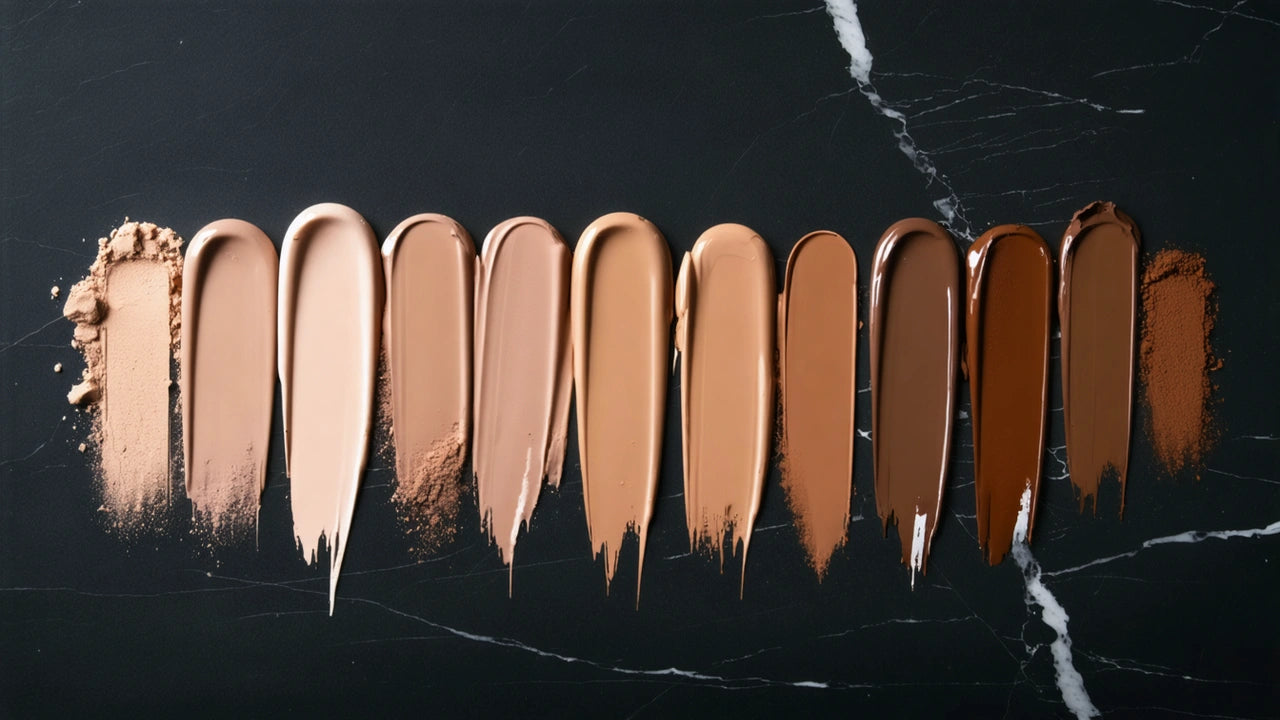
To find your SUGAR foundation shade for Indian skin, identify your undertone (most Indian skin is warm), then match to SUGAR's shade range: Cappuccino and Caramel shades suit medium-to-dusky tones, while Espresso covers deep complexions. Always swatch on the jawline in natural light.
Now for the good part: the actual shade names. Here is how to navigate SUGAR's shade range from fair to deep, including the specific pitfalls to avoid at every depth.
Fair to light: avoiding ashiness and pink casts
Fair-skinned Indian women face a specific problem: most "light" foundation shades on the market are formulated for fair Western complexions with pink or neutral undertones. Applied on a fair Indian complexion with a warm undertone, these shades oxidise pink, look artificially light, or sit completely flat — none of which are goals. In the SUGAR range, look for shades in the Ivory and Beige family and swatch them on your jawline (never the back of your hand — which is often a shade or two darker due to sun exposure). The right shade will vanish into your jawline within 30 seconds of blending. If it looks lighter than your neck, go one shade deeper. If you see a pink tinge after five minutes of wear, the formula is too cool — move to the warmer option in the same depth range.
Medium to wheatish: the most complex matching zone
Medium and wheatish complexions — sometimes described as "wheatish" in Indian beauty conversations, mapping roughly to NC35–NC42 — are the most populated shade zone in India and also the most commonly mis-shaded. The challenge: this depth range has the widest undertone variation. Some medium Indian complexions are golden-warm, others have an olive tint, and some lean neutral. SUGAR's Caramel and Honey shades sit in this zone and are specifically calibrated for warm-golden Indian medium complexions. The Caramel shade is the brand's bestseller in this range for a reason — it hits the sweet spot of warm, buildable, and natural-looking across a wide swathe of wheatish Indian tones. If you are building coverage over dark spots or hyperpigmentation, the foundation stick in Caramel paired with a concealer in a half-shade lighter gives a seamlessly natural result.
Dusky to deep: the shades that celebrate, not just cover
Deep brown Indian complexions — Fitzpatrick Type V and above — have historically been the most underserved by foundation ranges globally. SUGAR's Cappuccino and Espresso shades were developed as a direct answer to this gap. The Ace of Face Dewy Foundation in 15 Cappuccino specifically celebrates the rich warmth of deep Indian complexions rather than attempting to neutralise or flatten them. For very deep complexions, Espresso delivers the same warm-brown depth with enough coverage to unify skin tone without ever reading as a mask. The philosophy behind these shades is explicit: deep Indian skin is not a coverage problem to solve — it is a complexion to enhance.
For Indian women navigating both sun-induced pigmentation and post-acne marks on deeper complexions, pairing a warm-undertoned foundation with a targeted treatment like a Vitamin C serum underneath can significantly reduce the appearance of uneven tone over time. This guide on Vitamin C serums for pigmentation on Indian skin breaks down exactly which form of the ingredient works best under makeup.
Does SUGAR Foundation Cover Dark Spots and Hyperpigmentation?
Yes — but the answer comes with important nuance. Post-inflammatory hyperpigmentation (PIH) from acne, sun damage, and hormonal melasma are three of the most common skin concerns for Indian women, and foundation is often the first line of cosmetic defence. The mechanism is straightforward: foundation pigments physically obscure the appearance of darker patches by creating a film of matching skin-tone colour over the surface. But the level of coverage required depends on the depth and spread of the hyperpigmentation.
Full-coverage vs. buildable coverage: which to choose
Full-coverage foundations lay down a complete, opaque film that masks spots in a single layer. Buildable-coverage formulas allow you to start light and add where needed, which is ideal for uneven hyperpigmentation — heavy in some areas, lighter in others. For most Indian women dealing with scattered dark spots rather than broad pigmentation, buildable coverage gives a more natural, skin-like result. The Ace Of Face Foundation Stick is buildable — one pass gives medium coverage, two passes give full — making it more versatile than a one-weight formula for spot-masking without going cakey.
Foundation and concealer layering for maximum spot coverage
The most effective technique for covering deep hyperpigmentation with SUGAR cosmetics: apply your foundation all over first to even out the overall skin tone, then use the Auto Correct Creaseless Concealer in 07 Vanilla Latte — a half-shade lighter than your foundation shade — precisely on dark spots and set immediately with translucent powder. This colour-correction-through-concealer technique is a standard in professional makeup artistry: the lighter concealer slightly counteracts the darkness of the spot before the foundation colour reads on top.
Non-comedogenic formulas: safe for acne-prone skin
For Indian women whose hyperpigmentation is caused by acne in the first place, using a pore-clogging foundation is counterproductive. SUGAR's foundation formulas are non-comedogenic — meaning they are formulated to avoid blocking pores — and are cruelty-free, vegan-friendly, and tested for safety on Indian skin types. Dermatologists recommend looking for non-comedogenic labelling specifically for acne-prone and combination-oily Indian skin, which is prone to congestion in the humid Indian climate. If you want to layer your summer-proof routine, these sweat-proof makeup tips for the Indian summer show how to keep your SUGAR foundation locked in place for 8+ hours even through heat and humidity.

How to Apply SUGAR Foundation for a Flawless Finish
The best shade in the world will look wrong if the application is off. Foundation technique is where most people lose the plot — too much product, wrong tool, or no setting step. Here is the no-fail SUGAR method.
Tools: kabuki brush vs. beauty sponge for Indian skin
Both tools work — but they deliver different finishes. A damp beauty sponge presses product into skin for a seamless, skin-like finish that looks natural and dewy. A kabuki brush buffs and blends for more coverage with an airbrushed effect. For oily or acne-prone Indian skin, the Blend Trend Foundation Brush 052 Kabuki is the stronger pick — it builds coverage without pushing excess product into pores, and the dense bristles distribute the formula evenly without streaks. For dry skin, a damp sponge delivers that coveted second-skin finish that the dewy foundation is built for.
The 3-step application method for oily skin
- Prime first: Apply the Base Of Glory Pore Minimizing Primer all over the face and let it set for 60 seconds. This creates a smooth, grip-ready surface and minimises pore appearance before any foundation goes on.
- Buff in circular motions: Dot the Ace Of Face Foundation Stick directly onto the forehead, cheeks, nose, and chin. Using the kabuki brush, buff in small circular motions starting from the centre of the face outward. Build a second layer on areas with hyperpigmentation or uneven tone.
- Set with powder: Dust the SUGAR POP Banana Powder lightly over the T-zone and any areas prone to oiliness. Banana powder's yellow-toned silica absorbs sebum while colour-correcting any residual dullness, keeping foundation locked for 12 hours even in India's most punishing weather.
Setting with banana powder for 12HR wear
Banana powder deserves its own moment. The yellow undertone in banana powder is not just aesthetic — it actively cancels out the blue and purple tones that make skin look tired or ashy under artificial lighting, a concern particularly relevant for Indian skin under office fluorescents or evening event lighting. SUGAR POP Banana Powder is finely milled enough to set foundation without adding visible texture, and its oil-absorbing silica base locks wear for up to 12 hours without requiring a mid-day touch-up. For a deeper comparison of setting powders, this breakdown of compact powder vs. loose powder vs. banana powder will help you pick exactly the right format for your skin type and routine.
Frequently Asked Questions About sugar foundation
Which SUGAR foundation shade is best for Indian skin?
For Indian skin tones, SUGAR foundations in the W (warm) and N (neutral) undertone families — ranging from shades 10N to 40W — tend to work best, since most Indian complexions lean warm, golden, or olive. Fair-to-wheatish skin tones typically suit shades in the 10–20 range, medium-dusky skin fits 25–35, and deeper skin tones match beautifully with 40 and above. Always swatch on your jawline in natural light before committing — your neck doesn't lie!
Does SUGAR foundation cover dark spots and hyperpigmentation?
Yes, SUGAR foundations offer buildable to full coverage that effectively conceals dark spots, hyperpigmentation, and uneven skin tone in most formulas. The Ace Of Face Foundation Stick and Time To Shine Foundation, for instance, deliver medium-to-full coverage with a single layer and can be built up for deeper discolouration without looking cakey. For stubborn spots, prepping skin with a colour-correcting primer before foundation application gives you that extra edge.
How do you choose the right foundation shade for dusky skin?
Choosing the right foundation for dusky skin starts with identifying your undertone — most dusky Indian skin tones have warm (yellow-golden) or neutral undertones, so look for shades labelled W or N in the mid-to-deep range. Avoid foundations with a strong pink or grey base, as they can make dusky skin look ashy or flat. Swatch two to three shades on your jawline in daylight, wait 60 seconds for oxidation, then pick the one that disappears into your skin — that's your match.
Which SUGAR foundation is best for oily skin?
The SUGAR Cosmetics Ace Of Face Foundation Stick is widely considered the best pick for oily skin, thanks to its matte, long-wear formula that controls shine and stays put through humid Indian weather. It's transfer-resistant and sits comfortably on the skin without sliding. For extra staying power, pair it with a mattifying primer and set it with SUGAR's Blend & Blur Finishing Powder to lock everything in place — even on the sweatiest of days.
Can I use SUGAR foundation without a primer?
Yes, you can use SUGAR foundation without a primer — most formulas are designed to perform well on their own, especially on normal-to-dry skin. That said, if you have oily or combination skin, a mattifying primer dramatically improves longevity and prevents midday meltdowns. For dry or mature skin, a hydrating primer helps the foundation glide on more smoothly and prevents it from settling into fine lines. Think of primer as your foundation's hype person — not mandatory, but highly recommended.
Match Made. Now Shop It.
Your perfect foundation match is not a myth — it is a shade name and a formula away. Whether you're a warm-medium Caramel or a deep-warm Espresso, SUGAR has built the entire range around your complexion, not around someone else's. Stop settling for "close enough." Start with your undertone, pick your formula, and wear it like you mean it.
- Shop Ace Of Face Foundation Stick — full coverage, all day, every tone
- Shop Ace of Face Dewy Foundation in 15 Cappuccino — for glowy, medium-to-deep skin
- Shop Aquaholic Priming Moisturizer — prime, hydrate, and tint in one
- Shop Blend Trend Kabuki Brush 052 — the tool that makes every shade land right
Not sure where to start? Get every foundation question answered by experts — from finish to formula to how to make it last through a 14-hour wedding day.