

The best contour for Indian face shapes is soft shading in a cool-leaning shade about two steps deeper than your skin, placed where your natural shadows already fall. That means a diagonal line under the cheekbones on a round face, the jaw corners on a square face, the temples on a heart face and a light cheek sweep on an oval face. Contour is shading, not reshaping. Your face is not a problem to fix. You are just adding a little depth so your features show up in photos, under shaadi lights and across a crowded mandap.
How Do You Pick the Right Contour Shade for Indian Skin?
Shade first, placement second. Get the shade wrong and even perfect placement looks like a muddy stripe. Get it right and a beginner's blend still looks expensive.
Two shades deeper, cool-leaning
Real shadows are cool and slightly grey, not orange. So your contour should be roughly two shades deeper than your skin, leaning neutral to cool. Here's the basic idea: a deeper, cooler tone tends to read as shadow, so the area looks like it sits further back. Bronzer does a different job. It adds warmth where the sun would hit you, not depth.
Fair, wheatish, dusky and deep picks
Most Indian skin falls somewhere between Fitzpatrick III and V, with warm, olive or neutral undertones. That's why a very grey contour can look ashy on deep skin, and a very warm one turns brick-orange on wheatish skin.
- Fair: a soft, light taupe. Anything darker turns into a dirty-looking smudge on light skin.
- Wheatish or medium: a mid taupe or soft cocoa, so the shadow looks natural and not grey.
- Dusky: a cocoa with a neutral base. This is the sweet spot for a contour shade for dusky skin that won't go ashy.
- Deep: a deep espresso or rich chocolate with a little warmth, so the shading shows up but stays soft.
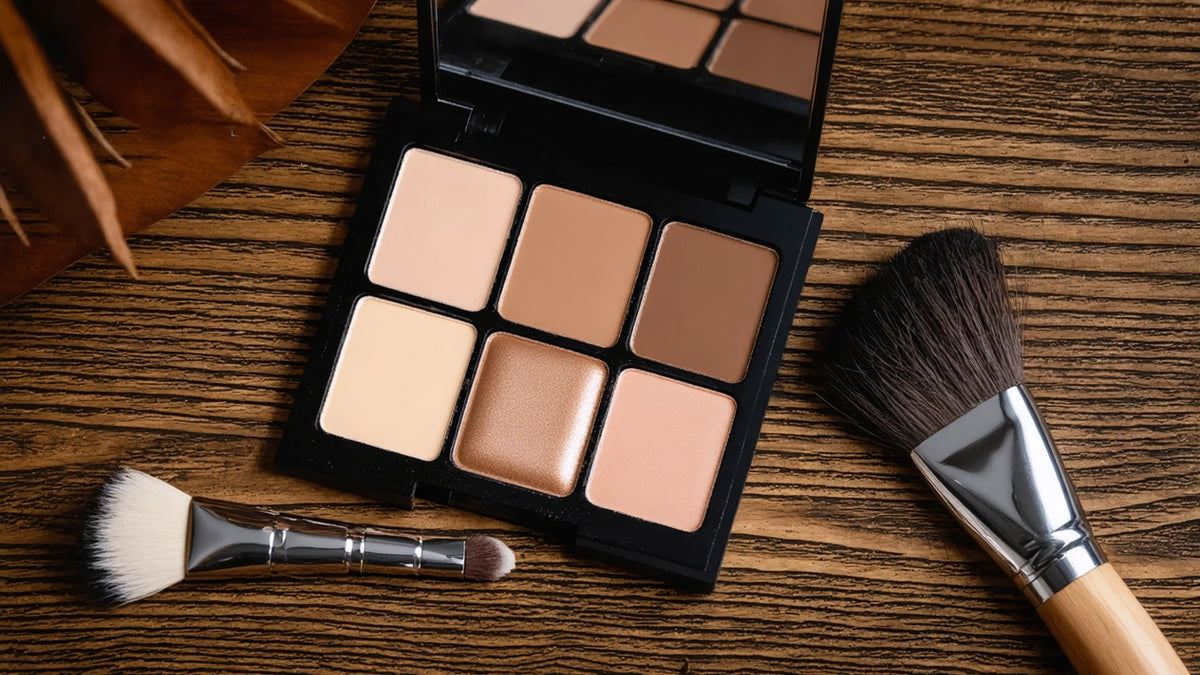
A palette makes this easier because you can mix. The Contour De Force Face Palette keeps contour, blush and highlight in one compact. Tap two shades together on your brush until the colour looks like your own shadow, not a stripe painted on top.
Avoid the orange stripe
Swatch along your jawline in daylight, near a window, not under bathroom tube lights. If the swatch melts into a shadow, you've found your shade. If it reads orange, go cooler. If it reads grey, go warmer. The same undertone logic applies to the glow you put on top, so check our guide to choosing a highlighter shade for Indian skin before you buy.
How Do You Find Your Face Shape for Contouring?
You don't need an app. You need a mirror and about 60 seconds.
The mirror-trace trick
Tie your hair back and stand an arm's length from the mirror. Trace the outline of your face on the glass with an old lipstick or kajal (washable, please). Step back and look at the shape you drew, not at your face.
Round, oval, square, heart
- Round: width and length are almost equal, with full cheeks and a soft, curved jaw.
- Oval: longer than it is wide, with a forehead slightly wider than a gently curved jaw.
- Square: forehead, cheeks and jaw are roughly the same width, with defined jaw corners.
- Heart: a wider forehead and cheekbones that taper to a narrower, softer-pointed chin.
Somewhere in between? Most faces are. Pick the closest shape and borrow one step from its neighbour.
Where Should You Place Contour for Each Face Shape?
Contour placement depends on face shape. On a round face, shade a diagonal line from the top of the ear toward the mid-cheek, under the cheekbone. On a square face, soften the jaw corners and outer temples. On a heart face, shade the temples and just under the chin. On an oval face, sweep lightly under the cheekbones only.
| Face shape | Where to contour | Where to skip |
|---|---|---|
| Round | Diagonal line under the cheekbone, ear toward mid-cheek | Heavy jaw shading |
| Square | Jaw corners and outer temples | A straight, sharp cheek line |
| Heart | Temples, hairline edges, just under the chin | The jawline |
| Oval | Light sweep under the cheekbones | Forehead and jaw |
Start with a cream or matte base already on. Use a fluffy angled brush and very little product. You can add more. Taking it off is the annoying part.
Round: diagonal cheek line
- Find the hollow. Suck your cheeks in lightly and feel for the soft dip under your cheekbone.
- Draw on the diagonal. Start at the top of your ear and angle toward the middle of the cheek. Stop in line with the outer corner of your eye.
- Blend upward. Buff in small circles toward the cheekbone so the edge disappears. A diagonal line adds definition. A blended one keeps it believable.
Square: soften the jaw corners
- Shade the corners. Tap contour onto the angle of your jaw, just below the ear, and blend down onto the neck.
- Touch the temples. Sweep a little along the outer forehead, near the hairline.
- Keep the cheek soft. Use a short, curved cheek stroke instead of a long, straight line, so the overall look stays rounded and soft.
Heart: temples and under the chin
- Shade the temples. Blend contour in a C-shape around the outer forehead and temples.
- Tap under the chin. A light touch just under the tip of the chin softens the point. Don't shade the front of it.
- Go short on the cheeks. Keep the cheek line short and high, ending well before the mid-cheek.
Oval: light cheek shade only
- One sweep. Lightly shade under the cheekbones with whatever product is left on your brush.
- Stop there. Oval faces are already balanced. Skip the forehead and jaw and save your effort for blush and lips.
How Do You Contour a Flat or Soft Nose Bridge?
Low, soft and wide nose bridges are common across Indian faces, and they're beautiful just as they are. Nose contour is optional. It adds a little definition for photos and stage lights, nothing more. If you love your nose untouched, skip this section and go straight to blush.
Two soft side lines
- Start at the brows. Using your lightest contour shade, draw two thin lines from the inner corners of your brows down each side of the bridge.
- Keep them parallel. For a flat nose bridge, keep the lines a little closer than your natural edges, but don't squeeze them so close that they look drawn on.
- Soften the tip. If you like, tap a tiny bit just under the tip. A dot is enough.
Blend with a small brush
- Use a small, tapered brush. A big brush muddies the whole nose. A small eyeshadow blending brush keeps it precise.
- Blend outward only. Buff each line toward the cheek, never toward the centre, so the middle of the bridge stays bright.
When Do You Apply Blush After Contour, and How Do You Make It Last in Humidity?
The order matters: base, contour, blush, set. Cream-on-cream blends most easily, so smooth on the Ace Of Face Foundation Stick first and blend your contour over it while the base is still a little tacky. Not sure your base will take shading well? Our BB cream vs foundation stick guide explains how the two compare on coverage and finish.
Blush placement after contour
Blush goes just above your contour line, on the apples, then blended back toward the temple. This sits colour right on top of the shadow and makes the cheekbone look lifted, no harsh lines needed. On round faces, start blush slightly further back from the nose. On heart faces, keep it on the outer cheek. A compact like the Contour De Force Mini Blush is easy to throw in your clutch for touch-ups between pheras and photos.

Match the blush family to your lips and you look put-together without trying. Dusky girls, pair a berry or brick cheek with our lipstick shade guide for dusky Indian skin, or keep it fresh with a sheer tint from our lip gloss shades guide for Indian skin tones.
Grand Finale Matte Setting Mist for humid days
Indian wedding season is humid, crowded and full of dancing, so sweat and oil can move contour around. Press a light layer of powder only where you get shiny, usually the T-zone and around the nose. Kaolin clay is a mineral clay often used in powders because it can help soak up surface oil, which is why a kaolin-clay compact makes sense here.

Finish with a few spritzes of the Grand Finale Matte Setting Mist from an arm's length away and let it dry on its own. Don't touch it. Before the baraat, blot with tissue and press, rather than adding layer after layer of powder. That's how contour stays soft at midnight instead of cakey.
Frequently Asked Questions About contour for Indian face shapes
How do I contour a round face to look more defined?
Start by sweeping a matte contour shade from your ear down towards the hollow of your cheek, stopping below the pupil. Then add a little along the temples and jawline. Blend upwards, not downwards, so the face looks lifted rather than muddy. Keep highlighter on the high points: centre of the forehead, top of the cheekbones and chin. Use a light hand, build in thin layers, and blend until you can't spot an edge. Matte beats shimmer for shadows every time.
How do I contour a flat nose bridge without it looking streaky?
Draw two thin, soft lines down the sides of your nose with a matte shade, then blend with a small, fluffy brush until the lines vanish. Add a light highlight down the centre only, not wide. Keep the lines close together for a slimmer look, and fade them into your brow inner corners. Streaks usually mean too much product or a dense brush, so tap off the excess first. Set with a pinch of translucent powder if your nose gets oily by afternoon.
Which contour shade suits dusky skin?
Pick a matte contour that is two to three shades deeper than your skin tone with a neutral to warm-brown undertone. Dusky skin can turn ashy with cool, grey-toned browns, and orange-heavy shades can look patchy. Swatch along your jawline in daylight, not on your wrist. If it disappears when blended, it's too light. If it sits like a stripe, it's too dark or too cool. Chocolate and cocoa-leaning browns usually blend into deeper Indian skin tones most naturally.
Should I contour before or after powder?
It depends on your formula: cream contour goes on before powder, and powder contour goes on after. Cream products blend best on bare or foundation-covered skin, then a light dusting of powder sets them. Powder contour needs a set base, otherwise it grabs onto damp patches and turns blotchy. In humid weather, set your T-zone first, then contour the cheeks. Always finish with a gentle blend so the layers melt together rather than sit on top of each other.
Can I use contour on oily skin in humid weather?
Yes, you can, but choose a matte powder contour and keep your base light. Heavy creams slide around when you sweat. Prime and set your face first, then apply powder contour with a fluffy brush in thin layers. Skip shimmer in the shadow areas, because it adds shine that exaggerates oiliness. Finish with a setting spray to help the look stay put through a long, muggy day or a wedding function.
Shop SUGAR Cosmetics
Save this routine for your next wedding function. Pick your shade, trace your shape and blend until it's soft. Then lock it all in with the SUGAR POP 20 HR Longwear Compact, so your contour lasts from haldi selfies to the last dance. Cruelty-free, wallet-friendly and made for Indian weather. Go shine, babe.