

SUGAR Concealer Shade Guide: Cover Everything, Match Perfectly
A concealer is a pigment-rich complexion product used to neutralise discolouration, cover dark circles, and blur post-acne marks — but only when you've matched the shade correctly. Get it wrong and you're not hiding anything; you're highlighting it. The good news: finding your perfect sugar concealer shade for Indian skin is a three-step process, not a guessing game. This guide covers everything from undertone science to application technique so you cover it all, confidently.
To find the right SUGAR concealer shade for Indian skin: match your undertone (most Indian skin is warm), go one to two shades lighter for under-eye use, and exact-match to skin for spot concealing. SUGAR's Auto Correct Concealer range covers warm, neutral, and golden undertones across fair-to-deep Indian complexions.
Why Getting Concealer Shade Right Matters More Than Foundation
Your foundation covers a large, blurred canvas. Your concealer lands on precise, high-attention zones — under your eyes, over a fresh breakout, along an uneven patch. A slightly-off foundation reads as "not quite right." A slightly-off concealer reads as a neon sign pointing directly at the thing you were trying to hide.
For readers also navigating their base routine, Foundation Questions Answered by Experts covers the full picture of how concealer shade selection connects to your broader foundation match.
The Concealer-Too-Light Problem on Indian Skin: The 'Ghost Patch'
Pick up any global drugstore concealer and the lightest three shades are variations of beige-pink. Wear any of them on medium-to-deep Indian skin and you've created what beauty communities have dubbed the "ghost patch" — a pale, ashy ellipse under each eye that's more visible than the dark circle you were covering. The problem is undertone mismatch compounded by depth mismatch. Pink-based concealers cancel out the warm, golden base of Indian complexions and create a cool, chalky contrast.
Why Warm Undertones Are Non-Negotiable for Indian Concealers
Indian skin tones — spanning Fitzpatrick types III through V — predominantly carry warm (yellow-to-golden) undertones in the dermis. Research published in the International Journal of Dermatology confirms that melanin distribution in type III–V skin produces a yellow-ochre base tone that reads as "warm" across the visible light spectrum. A concealer with a cool or neutral-pink base sits on top of this, rather than blending into it. Cosmetic scientists note that the iron oxide pigment ratios in a concealer's formula are the primary determinant of undertone — not just the overall depth. SUGAR's Auto Correct range calibrates its iron oxide ratios specifically for warm and golden Indian undertones.
Full Coverage vs. Buildable Concealer: What's Your Skin Concern?
Dark circles on Indian skin are often a combination of hyperpigmentation and translucency — meaning both deep colour and visible capillaries. Post-acne marks (PIH, or post-inflammatory hyperpigmentation) are flat but intensely pigmented. A full coverage concealer handles PIH and stubborn dark circles in fewer layers. Buildable formulas are better for everyday brightening where heavy coverage would look cakey. Know your concern; choose your coverage level accordingly.
How to Find Your SUGAR Concealer Shade in 3 Steps
Step 1: Identify Your Undertone
Check the veins on your inner wrist in natural daylight. Green or olive veins = warm undertone. Blue or purple veins = cool undertone. A mix = neutral. For most Indian women, the answer is warm or neutral-warm. If you're unsure, go warm — it blends into Indian skin chemistry far more forgivingly than a cool shade ever will.
Step 2: Choose Coverage Level for Your Concern
- Under-eye darkness and discolouration: Go one to two shades lighter than your skin tone, warm undertone. A slightly lighter shade reflects light upward and reduces the appearance of hollowness.
- Dark spots, acne marks, and hyperpigmentation: Exact-match to your skin tone. Going lighter creates a pale bull's-eye effect over the spot.
- All-over brightening and base smoothing: One shade lighter, blended outward — this is the "no-makeup makeup" approach.
When reinforcing that your concealer and foundation shades must work together — not independently — How to Choose the Right Foundation for Indian Skin is the companion read.
Step 3: Test the Formula — What to Look For
Swatch on your jawline, not your hand. Your jaw matches your face; your hand doesn't. Let the swatch sit for two minutes — some concealers oxidise slightly. The right shade disappears. The wrong shade stands out. For Indian skin, also look for the word "creaseless" or "non-settling" on the label; fine under-eye lines show product texture faster on mature or dry skin types.

SUGAR Concealer Shade Guide: Fair to Deep Indian Complexions
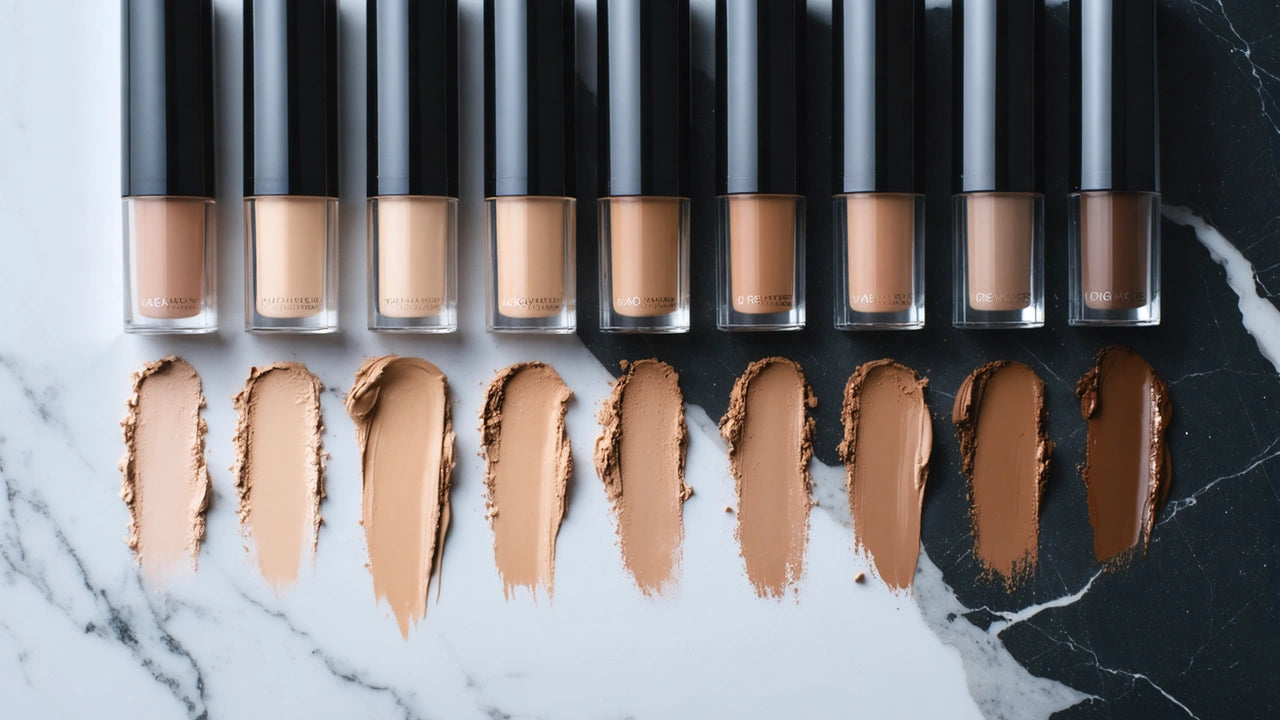
The SUGAR Auto Correct Creaseless Concealer range spans undertones from warm-neutral to deep-golden, making it one of the most inclusive concealer lines formulated for the actual breadth of Indian skin. Here's how to navigate it by depth:
Fair to Light: Avoiding Pink and Purple Casts
Fair Indian skin often has a yellow or peachy undertone that gets obliterated by cool-pink global concealer shades. Look for shades in the SUGAR Auto Correct range labelled "Ivory" or "Porcelain" — these carry a warm-neutral base that unifies with fair Indian complexions rather than sitting on top of them as a pinkish mask. Under-eye: go one shade lighter within the warm family, not into cool territory.
Medium Wheatish: The Most Nuanced Matching Zone
Medium Indian skin — the classic "wheatish" complexion — is the trickiest zone because it sits exactly where warm and neutral overlap. Shades like Auto Correct Creaseless Concealer in 07 Vanilla Latte are calibrated for this complexion, delivering a golden-neutral base that works for both spot concealing and under-eye use on medium Indian skin. This is the #1 shade for Indian skin in the mid-range, and for good reason — it covers without contrast.
Dusky to Deep: Warm Tones That Celebrate, Not Just Conceal
Deep Indian skin tones are chronically under-served by concealer ranges that top out at "medium." The SUGAR Auto Correct range extends into rich golden-brown depths where the formula's warm iron oxide ratio ensures the product melds with deeper complexions instead of sitting ashy. For deep skin, the rule is especially firm: never go more than one shade lighter for under-eye use, or the contrast is starker than the original darkness. Spot conceal at an exact shade match every time.
Concealer for Dark Circles on Indian Skin: The Right Shade Trick
Dark circles are the #1 concealer concern for Indian women — and they're stubborn for a reason. Under-eye darkness on Indian skin (Fitzpatrick III–V) is typically a mix of periorbital hyperpigmentation (melanin deposits in the superficial dermis) and vascular pooling. A study published in the Journal of Cutaneous and Aesthetic Surgery found periorbital hyperpigmentation to be significantly more prevalent in South Asian populations than in European cohorts, with melanin-driven discolouration being the dominant contributor in over 60% of cases. Standard concealer alone can struggle with the intensity of this pigmentation.
Why Indian Under-Eye Darkness Needs Colour Correction First
Melanin-driven dark circles present as brownish-purple. A peach or orange colour corrector — applied as a thin, tapped layer before your concealer — neutralises this underlying cast before you even reach for coverage. Think of it as priming the canvas: the corrector doesn't cover; it cancels. Then your concealer covers a neutralised base, requiring fewer layers and delivering a cleaner, lighter result.
Peach or Orange Corrector Before Concealer for Deep Circles
Fair to medium skin: peach corrector. Medium to deep skin: orange or salmon corrector (the deeper the skin, the more orange the corrector needs to be to counteract the purple-brown undertone of the darkness). Apply with your ring finger using a gentle tapping motion — never drag the under-eye skin, which is three to five times thinner than facial skin and prone to traction damage.
Setting Under-Eye Concealer So It Doesn't Crease
India's climate — humid from June to September and dry-hot from March to May — is brutal on under-eye concealer. Humidity causes even the best formulas to migrate into fine lines within two hours. Set immediately after application using a fluffy brush and a translucent or banana-toned powder, pressing (not sweeping) the powder into the skin. This baking technique locks the concealer and extends wear from a few hours to a full day. The SUGAR POP Banana Powder is ideal for this — its yellow-toned formula brightens and sets simultaneously, without adding visible texture.

Concealing Acne Scars and Dark Spots on Indian Skin
Post-inflammatory hyperpigmentation (PIH) is disproportionately common on Indian skin. When a breakout heals, it triggers excess melanin production — leaving flat, dark marks that can persist for months. Concealer is your immediate-wear solution while your skincare works on the underlying pigmentation.
Spot Concealing vs. All-Over Application
For PIH and acne scars, precise spot application beats all-over coverage every time. Use a thin, flat brush or a clean fingertip to press concealer directly onto the mark. Blend only the very edges — not the centre — to avoid diluting the coverage exactly where you need it most. Going over the whole face with concealer when you only need to cover three spots just adds unnecessary product weight.
Layering Concealer Over Active Products Without Pilling
If your skincare routine includes a niacinamide serum or salicylic acid treatment (both common in PIH-targeting routines), wait a full sixty seconds after skincare absorption before applying concealer. Silicone-based concealers and water-based actives are the classic pilling combo. Patting rather than rubbing during application dramatically reduces product disruption. For more on targeting the underlying pigmentation, the Niacinamide for Indian Skin Tone brightening guide breaks down ingredient layering in full.
The Non-Comedogenic Advantage: Safe for Breakout-Prone Skin
The irony of acne scar coverage is this: you need a concealer that covers your breakouts without causing new ones. SUGAR Auto Correct Creaseless Concealer is non-comedogenic — meaning its formula is designed not to block pores — making it safe to apply directly over active spots and healing skin without compounding the problem.
How to Apply Concealer Like a Pro: Techniques for Indian Skin
The Triangle Technique for Under-Eye Coverage
Forget the thin half-moon of product under your lower lash line. The triangle technique places concealer in an inverted triangle pointing down toward the cheekbone — covering the full orbital darkness and simultaneously creating a lifted, luminous effect. Blend the edges into your foundation using a damp beauty sponge for a seamless finish that reads as skin, not product.
Patting vs. Blending: Which Works for Your Formula?
Liquid and cream concealers respond to patting — a stippling motion with a fingertip or sponge that presses pigment into skin without sheer it out. Dragging or sweeping thins the coverage and activates the concealer's movement, pulling it off spots and into texture. Use a dense, flat concealer brush for spot work and a damp sponge for under-eye blending — two tools, two jobs, both done right.
Frequently Asked Questions About sugar concealer
What is the difference between a concealer and a foundation for Indian skin tones?
Concealer is a higher-coverage, targeted product designed to hide specific concerns like dark circles, acne scars, or hyperpigmentation, while foundation evens out your overall skin tone across a larger area. For Indian skin, this distinction matters extra — our skin often has uneven undertones (warm, golden, or olive) that foundation alone can't fully address in problem zones. Think of foundation as the base coat and concealer as your precision tool. The two work best together, with concealer a
Is SUGAR concealer safe for acne-prone skin?
Yes, SUGAR concealers are formulated to be skin-friendly and are suitable for acne-prone skin when applied and removed correctly. The key is to avoid heavy layering directly over active breakouts, which can clog pores and worsen inflammation. Always prep skin with a lightweight moisturiser, use a clean brush or sponge for application, and double cleanse at the end of the day. Choosing a matte-finish SUGAR concealer also helps control excess oil around blemish-prone areas without sliding off mid-
What are the benefits of using a colour-correcting concealer before your regular concealer?
Colour-correcting concealers neutralise problem tones before your regular concealer goes on, so you need less product overall and coverage lasts longer. For Indian skin specifically, peach or orange correctors cancel out the deep bluish-purple or greyish tones in dark circles — which are extremely common in South Asian complexions. Green correctors knock out redness from active pimples. Once the underlying tone is neutralised, your regular SUGAR concealer blends seamlessly on top for a natural,
How long does it take to see results from using concealer consistently on dark spots?
Concealer delivers instant visual results — it covers dark spots the moment it's applied, not after repeated use. However, it is a cosmetic product, not a skincare treatment, so it does not fade or reduce dark spots over time on its own. For long-term improvement of hyperpigmentation or post-acne marks on Indian skin, pair your SUGAR concealer routine with a skincare regimen that includes niacinamide, vitamin C, or AHAs. The concealer handles today; your actives handle tomorrow.
Can I use SUGAR concealer without foundation for a no-makeup makeup look?
Absolutely — SUGAR concealer works brilliantly as a standalone product for a fuss-free, no-makeup makeup look. Apply it only where you need it: under-eyes, around the nose, or on blemishes, then blend the edges well so it melts into bare skin. Set with a light dusting of translucent powder to prevent creasing. This spot-concealing approach is perfect for Indian skin on humid days when a full face of foundation feels too heavy but you still want to look polished and put-together.
Cover It All. Confidently.
You've got the shade science, the technique, and the full picture of what your skin actually needs. Now comes the best part: putting it to work. Whether you're covering a stubborn dark circle, a post-acne mark that's overstayed its welcome, or just building your first real base routine, SUGAR's concealer range was built for exactly your skin tone — not an afterthought of it.
Start with the Auto Correct Creaseless Concealer in 07 Vanilla Latte — the go-to shade for medium-dusky Indian skin. Set it for all-day hold with SUGAR POP Banana Powder. Cover everything. Match perfectly. Find your shade, cover your story.